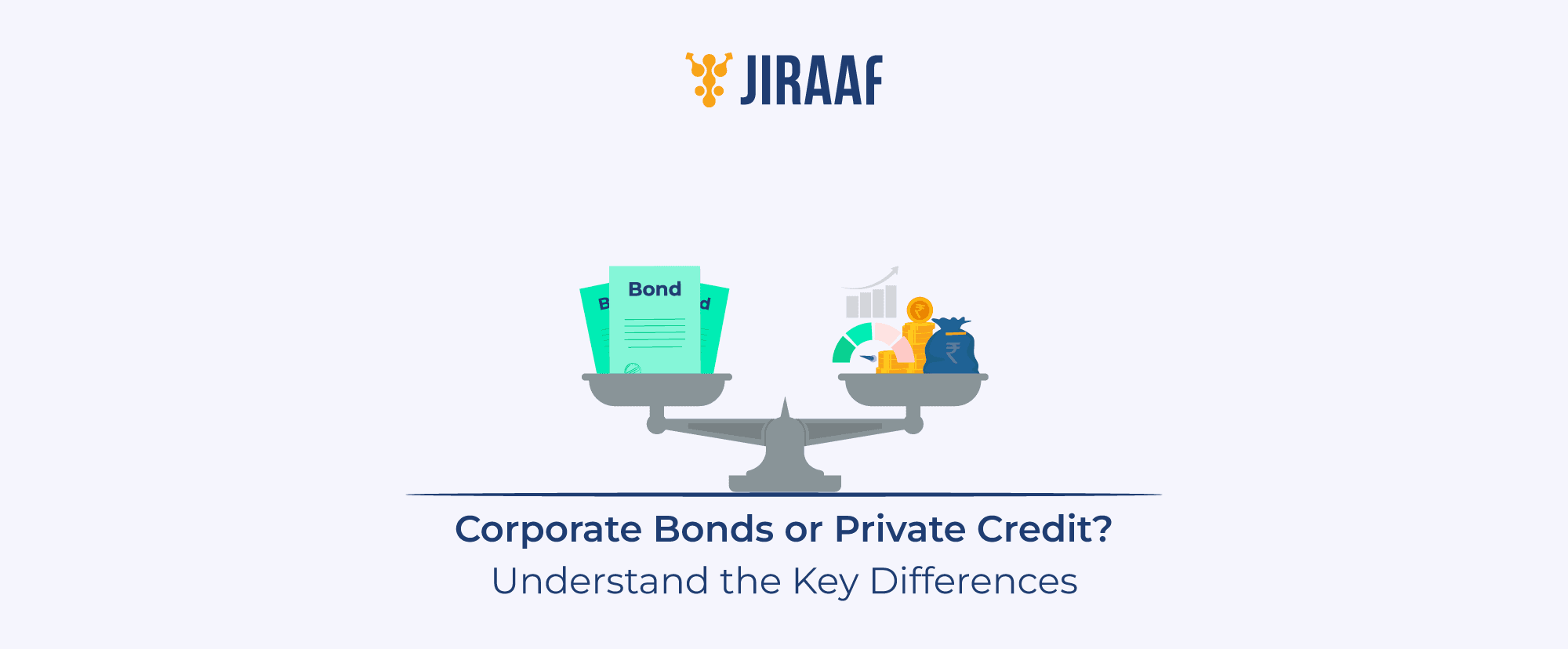
Private credit and corporate bonds offer two distinct ways to lend to companies. Understand how they work and which approach aligns better with your investment strategy.
If you have started exploring fixed-income investments, you would have likely come across corporate bonds and private credit as two common options. While both involve lending to companies, the way these products are structured and accessed is quite different.
In this blog, we will discuss how private credit and corporate bonds work, how companies raise capital through both routes, and what sets them apart. We will also break down their differences in terms of risk, liquidity, and yields, and explore their roles in fixed-income investing.
What is Private Credit?
Private credit refers to lending that takes place outside traditional banking and public debt markets, where companies borrow capital directly from institutions such as private credit funds, pension funds, Alternative Investment Funds (AIFs), or Business Development Companies (BDCs).
These are privately negotiated loan agreements in which the lender evaluates the borrower’s financial position, cash flows, and business model, and tailors the loan to the borrower’s specific needs. A private credit fund may also sanction loans to startups or mid-sized companies, which traditional banks can be hesitant to do.
For you as a retail investor, access to private credit typically comes indirectly. By investing in vehicles such as private credit funds or AIFs, you participate in a portfolio of such privately structured loans, which aim to generate higher yields compared to other traditional fixed-income instruments.
However, this higher return potential stems from the additional risks of private credit. These include lower liquidity, limited transparency, and greater dependence on the borrower’s financial health. Broadly, the private credit space has also come under scrutiny in recent years. In the U.S., rising defaults, redemption pressures, and valuation concerns have highlighted vulnerabilities in a market estimated at $2 to 2.5 trillion, even as it is projected to grow further.
As a result, while private credit can serve as a yield-enhancing component in a portfolio, it requires careful evaluation. If you seek greater transparency, liquidity, and relatively predictable risk, publicly issued instruments such as corporate bonds tend to offer a more structured and accessible alternative.
What are Corporate Bonds?
Corporate bonds are debt instruments issued by public companies to raise debt capital. When you invest in a corporate bond, you are essentially lending money to the issuer for a fixed period. In return, the company pays you periodic interest (coupon) and repays the principal amount upon maturity.
Compared with other debt products, corporate bonds are more trustworthy because they are assigned credit ratings. Agencies like CRISIL, ICRA, and India Ratings evaluate the bond issuer’s ability to repay and assign ratings from AAA to D. AAA indicates the highest level of safety, while D signals default.
A more sensible approach to investing in these bonds may be to buy bonds rated in the range of AAA to BBB-, as these have historically recorded lower default rates while offering yields in the range of 8% to 14%.
Source – Crisil
The above table illustrates the default rate of publicly listed bonds over a three-year period. Notably, the default rate remains relatively contained at 2.21% up to the CRISIL BBB credit rating.
Understanding the Corporate Debt Market in India
India’s corporate bond market has grown significantly, reaching around ₹53.6 lakh crore (FY2025) and accounting for roughly 22.5% of the overall bond market. Despite this growth, it remains relatively underdeveloped when compared to nations like the U.S., Japan, Germany, etc. According to a recent NITI Aayog report, the Indian corporate bond market contributes 15 to 16% of GDP, with limited retail participation and low secondary market liquidity.
That said, improving regulations, rising investor interest, and policy support indicate strong potential. With ongoing reforms, the market is expected to double at ₹100 trillion by FY2030 and play a larger role in funding infrastructure and long-term economic growth.
However, understanding the market is one part, but distinguishing between private credit and corporate bonds is what helps you make better investment decisions.
Private Credit vs Corporate Bonds: Key Differences
| Parameter | Private Credit | Corporate Bonds |
| Risk | Higher risk due to exposure to mid-sized or less transparent borrowers, with deal-specific structures and limited disclosure | Relatively lower risk (especially investment-grade), supported by credit ratings and regulatory oversight |
| Liquidity | Illiquid in nature, with capital typically locked in until maturity and limited exit options | More liquid, especially if listed, allowing you to buy or sell in the secondary market |
| Yield | Typically higher, ranging from 12% to 22% | Generally lower, ranging from 8% to 14%, depending on credit rating and tenure |
| Transparency & structure | Privately negotiated deals with limited public disclosure and customized terms | Standardized instruments with defined terms, publicly available information, and regulated disclosures |
Conclusion
Private credit and corporate bonds serve distinct but important roles in India’s evolving debt market. While corporate bonds provide transparent, regulated, and scalable access to capital, private credit fills critical funding gaps for mid-sized and emerging businesses that may not access public markets easily.
For investors, the choice depends on your approach. While corporate bonds suit those seeking stability, liquidity, and predictability, private credit may appeal to those willing to take on higher risk for potentially higher returns.