If you’re looking to diversify your portfolio beyond traditional investment options, such as stocks or mutual funds, alternative investment funds (AIFs) in India offer unique and off-market opportunities. These funds are not tailored for the common investor, but for high-net-worth individuals (HNIs) who seek access to unconventional high-risk, high-reward investment strategies.
In the sections ahead, we will discuss everything you need to know about what AIFs are, how they work, and how to evaluate if they’re the right fit for you.
What is an Alternative Investment Fund (AIF)?
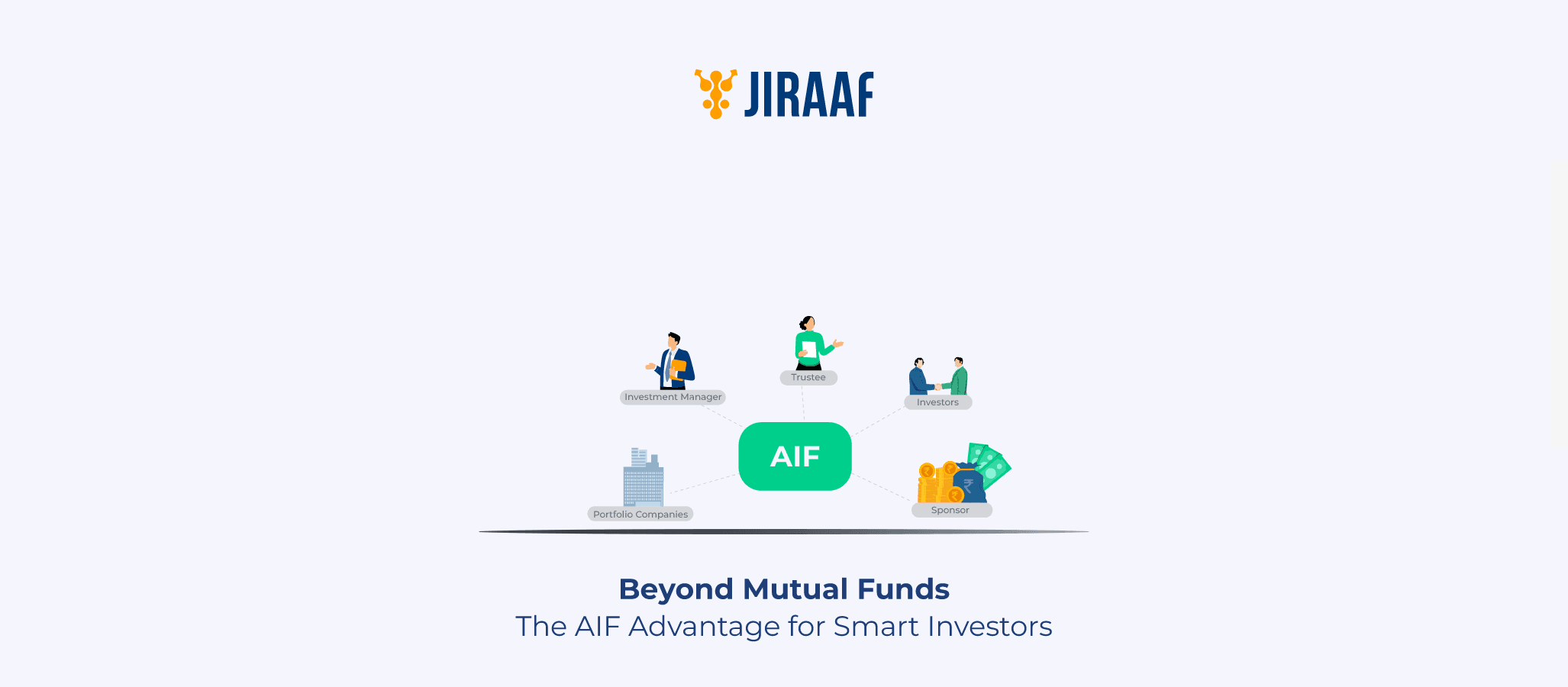
An alternative investment fund (AIF) is a privately pooled investment vehicle regulated by the Securities and Exchange Board of India (SEBI). These funds invest in a variety of non-traditional asset classes, including private equity, real estate, hedge funds, and venture capital.
As an alternative to traditional mutual funds, AIFs are designed for seasoned investors seeking specialized strategies outside public markets. SEBI defines AIFs under it’s 2012 regulations, with a minimum investment requirement of ₹1 crore per investor.
Since AIFs operate across diverse strategies and risk profiles, SEBI classifies them into distinct categories to regulate how capital is deployed, and risks are managed.
Categories of Alternative Investment Funds
The AIFs are divided into 3 categories.
Category I AIFs
Category I AIFs invest in organizations such as, star-up, or early-stage ventures, social ventures, SMEs, infrastructure or other sectors that are considered economically desirable by the government or regulators.
The government may often encourage them by offering tax benefits, regulatory support, or relaxed investment norms. Common examples of category I AIFs include venture capital funds, SME funds, infrastructure funds, and angel funds.
Category II AIFs
Category II AIFs are often referred to as a residual bucket because they do not fall under Category I or Category III. Also, they don’t undertake leverage other than for day‑to‑day operational requirements as permitted by SEBI.
However, these funds can use leverage for operational needs (e.g., short-term borrowing for expenses) but are barred by SEBI from speculative leveraging. They do not typically receive government incentives. Private equity funds, real estate funds, and debt funds are common examples of category II AIFs.
Category III AIFs
Category III funds employ complex strategies, including those that require taking leverage to generate high returns over short to medium-term horizons. These funds have a higher risk profile and may invest in derivatives like futures and options along with equities or other instruments with sophisticated trading strategies.
Category III AIFs include hedge funds, long-short equity funds, and Private Investment in Public Equity (PIPE) funds.
(Note: For detailed regulations, you can refer to SEBI’s official website www.sebi.gov.in)
While these categories define the nature and risk profile of AIFs, understanding how they operate in practice is essential to evaluating their suitability as an investment option.
How Do AIFs Work in India?
AIFs can be registered with SEBI as corporations, limited liability partnerships (LLPs), trusts, or body corporates. Here is how this procedure unfolds.
- Fund Setup: A clear investment strategy and mandate are in place when the fund is created.
- Capital Raising: Capital is raised by pooling the funds of eligible investors who satisfy SEBI’s eligibility requirements.
- Investment Execution: The fund manager adheres to the guidelines set forth by SEBI to implement the plan.
- Transparency: To ensure compliance and protect investors, funds must adhere to stringent disclosure, audit, and periodic reporting requirements.
AIFs often have lock-in periods ranging from 3 to 10 years, depending on the fund’s strategy; however, some Category III AIFs (e.g., open-ended hedge funds) may offer greater liquidity. It is recommended to review the fund’s Private Placement Memorandum (PPM) for specifics on lock-in periods and exit options.
Given their structure, long lock-in periods, and regulatory requirements, AIFs are not designed for every investor. This makes going through AIFs eligibility a key consideration for anybody evaluating AIF investment.
Who Can Invest in AIFs?
HNIs, institutional investors, family offices, and other high-level investors are the target market for AIFs. The following are eligibility requirements.
- Minimum contribution: Each investor must contribute a minimum of ₹1 crore.
- Exception for directors and employees: For all three categories (Category I, II, and III) of AIFs, a minimum investment of ₹25 lakh may be made by the AIF’s manager, directors, or employees. For all other investors, the regulatory minimum remains ₹1 crore, unless they are investing in an Angel Fund (min. ₹25 lakh) or qualify as ‘Accredited Investors’ under specific relaxed schemes.
- KYC: Investors are required to comply with the Know Your Customer (KYC) requirements as stipulated by SEBI regulations.
- Accredited Investors: Some AIFs may allow accredited investors (as defined by SEBI’s 2021 framework) to participate under relaxed regulations, such as lower minimum investment amounts, but this is optional and not mandatory for all funds.
For investors who meet these eligibility criteria, the next step is understanding what AIFs offer in return, and the risks that come with those opportunities.
Benefits and Risks of Investing in AIFs
There are several advantages as well as risks to investing in AIFs that investors should be aware of.
Benefits of Investing in AIFs
AIFs differ from traditional investments in both structure and strategy, which allows them to offer certain benefits not commonly found in public-market products.
- Customization: AIF funds use investment strategies that are specifically designed to target particular industries, opportunities, or risk profiles.
- Greater Return Potential: Investing in hedge funds, venture capital, or private equity can yield returns that exceed the market average, particularly in industries experiencing rapid expansion.
- Diversification: By providing exposure to assets that are less closely tied to public markets, including real estate or private equity, AIFs reduce portfolio volatility.
- Access to Niche Markets: AIFs enable investment in exclusive opportunities unavailable through traditional vehicles.
While AIFs offer differentiated return opportunities, they also come with structural and market-related risks that investors must evaluate carefully before committing capital.
Risks of Investing in AIFs
Here are the certain risks associated with AIFs.
- Illiquidity: Access to capital is restricted by the lock-in periods of the majority of AIFs, which typically range from 3 to 10 years.
- Increased Fees: AIFs raise expenses by charging management fees (1% to 2% per year) and performance-based fees (e.g., 20% of earnings above a hurdle rate).
- Complexity: To execute strategies successfully, careful due diligence and financial expertise are necessary for the investor.
- Higher Risk: There is a greater chance of capital loss when investing in unlisted businesses or leveraged techniques.
To better evaluate this trade-off between risk and reward, it helps to compare AIFs with more traditional investment avenues such as mutual funds and other public-market instruments.
AIFs vs Traditional Investment Options
| Characteristic | AIFs | Mutual Funds / Traditional Assets |
| Investment structure | Private, pooled, strategy-specific | Publicly pooled, regulated |
| Minimum investment | ₹1 crore | As low as ₹500 |
| Liquidity | Low (lock-in periods apply) | High (easy to redeem anytime for open-ended funds) |
| Returns | Potentially higher, strategy driven | Market-linked, typically moderate |
| Regulation | SEBI-regulated, fewer retail-centric protections | Highly regulated with investor safeguards |
| Access to alternatives | Yes (PE, VC, hedge funds) | No |
Beyond structure, liquidity, and returns, taxation plays a crucial role in determining the net outcome of an AIF investment.
Taxation of AIFs
Taxation varies by AIF category:
Category I and Category II AIFs
Category I and II AIFs generally enjoy tax pass-through status, meaning most income is taxed at the investor level rather than the fund level.
- Capital Gains
- Long-term capital gains (LTCG): 12.5% (listed and unlisted securities, effective July 23, 2024)
- Short-term capital gains (STCG): 15%
- Interest Income
- Taxed as per the investor’s applicable income tax slab
- Business Income Exception
- Any business income generated within Category I and II AIFs does not qualify for pass-through
- Such income is taxed at the fund level at the Maximum Marginal Rate (MMR) of 42.74%
Category III AIFs
Category III AIFs have traditionally been taxed at the fund level, but the taxation framework has evolved following the July 2025 Delhi High Court ruling, especially based on the trust structure.
- Determinate Trust Structure
(Where beneficiaries are clearly identifiable through KYC)
- Capital gains taxed at the investor level; with LTCG (listed) at 12.5% and STCG (listed) at 15%.
- Interest income taxed as per the investor’s applicable slab rate
- Indeterminate Trust Structure
(Where beneficiaries are not clearly identifiable or trustees have discretion)
- Traditional taxation treatment continues at the fund level; with LTCG (listed) at 12% effective and STCG (listed) at 18% effective.
- Interest income taxed at the Maximum Marginal Rate (MMR) of 42.74%. This includes 30% base tax, 37% surcharge (for income exceeding ₹5 crore), and 4% cess.
Key Regulatory Clarifications and Recent Developments
- Budget 2025 (Effective April 1, 2025 / AY 2025–26)
Securities held by Category I and II AIFs are explicitly classified as capital assets, ensuring that gains from their sale are taxed as capital gains at the investor level, and not treated as business income.
- From April 1, 2026
Long-term capital gains for Category III AIFs will be harmonized at 12.5%, aligning them with the broader capital gains tax framework and signaling further rationalization of AIF taxation in India.
Conclusion
In India’s financial ecosystem, alternative investment funds offer a unique opportunity to gain exposure to high-growth industries, specialized strategies, and less correlated assets. They aren’t for everyone, though. AIFs can enhance an investor’s typical portfolio and provide access to unique investment opportunities if they are financially stable, prepared to take risk, and willing to remain involved over the long term.
Before committing to an AIF for the first time, it is recommended to ways seek advice from a certified advisor, check whether you are eligible to invest, and ensure the fund aligns with your investment objectives.