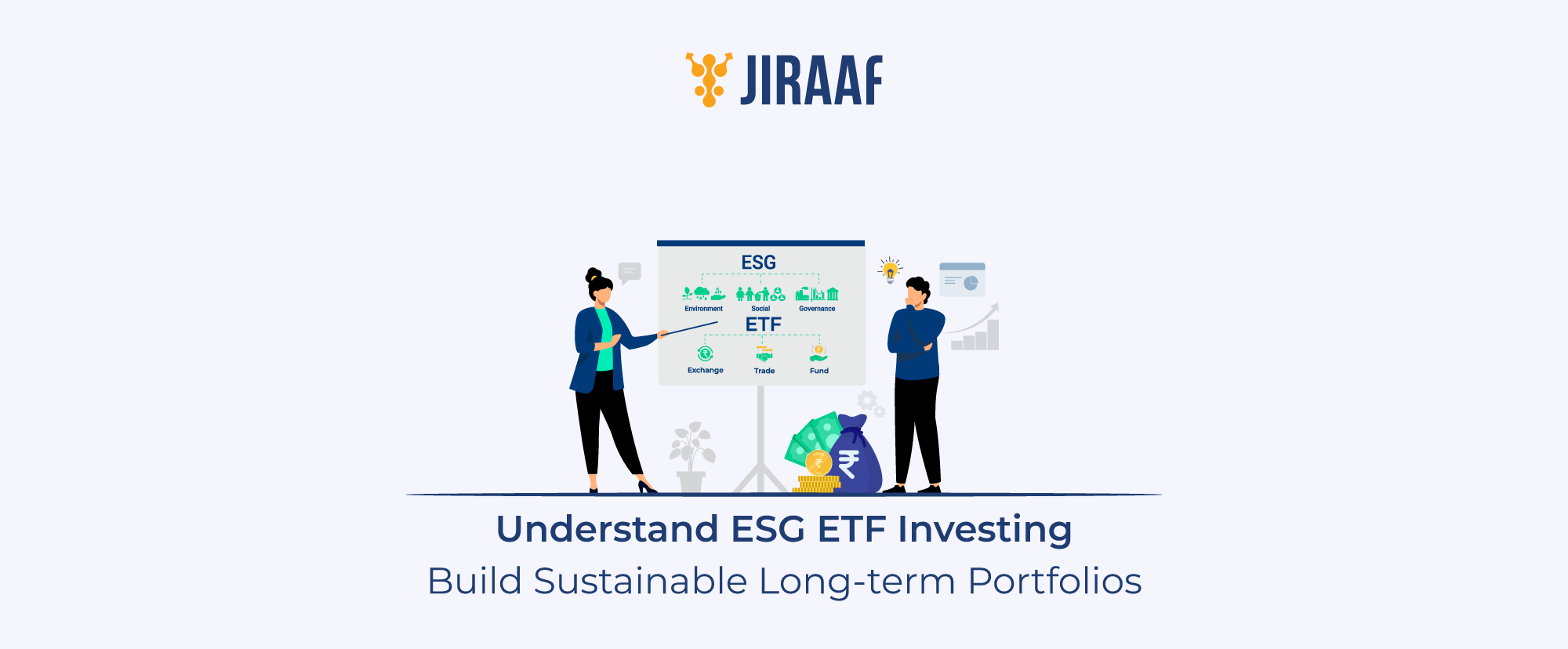
In this blog, you’ll get a clear sense of what ESG ETFs are and why they’ve become a core part of modern portfolio thinking. You’ll also understand how their screening methods shape long-term, principle-aligned investment strategies.
For investors who see sustainability as core to long-term corporate growth and competitiveness, ESG ETFs become a natural portfolio choice These ETFs enable investors to participate in long-term market growth while filtering companies based on their behavior, treatment of people, and level of responsibility.
ESG ETFs are not meant to replace traditional investments, but they offer an added layer of alignment between financial goals and personal values. In this blog, we will discuss what ESG ETFs are, their key components, advantages, disadvantages, and more.
Understanding ESG ETFs
An ESG ETF scans a basket of stocks within a category (like Nifty 100) and applies its filters to find companies that meet its defined environmental, social, and governance standards. While traditional ETFs focus primarily on market capitalization, ESG ETFs integrate sustainability criteria alongside these financial benchmarks. These ETFs generally track indices like the Nifty 100 ESG, Nifty100 Enhanced ESG, and S&P BSE 100 ESG Index, and mirror their performance to generate meaningful returns for investors.
ESG ETFs attract investors who want to increase their portfolio allocation to companies that manage risks related to climate policies, labor issues, and transparency. This foundation gives way to a more practical question: what exactly goes inside these funds and what drives their construction.
Key Components of an ESG ETF Portfolio
Understanding the building blocks will help you evaluate what the fund emphasizes and where its strengths or limitations may appear.
Environmental (E)
The environmental segment assesses how companies manage their impact on natural resources. This can include carbon emissions, energy efficiency, waste handling, renewable energy usage, climate risk preparedness, etc. In many ESG indices, energy transition leaders and low-carbon business models form a significant share of the environmental filters.
Social (S)
The social segment looks at how companies interact with their employees, customers, and the broader community. The key metrics to evaluate this segment include workplace safety, data protection, customer treatment, community development, and supply chain labor standards. Here, the objective is to identify firms that invest in people-related aspects and directly influence long-term brand value and operational consistency.
Governance (G)
The governance segment examines the leadership quality of the company. In this segment, companies with independent oversight, transparent practices, ethical decision-making, a responsible compensation structure, and strong shareholder rights score higher. Governance forms the backbone of ESG evaluation because even strong environmental and social practices depend on credible leadership and accountability.
These pillars together create the portfolio structure of ESG ETFs. With this clarity, it becomes easier to understand the different types of ESG ETFs available for investors.
Types of ESG ETFs
The following are the most common types of ESG ETFs traded in India.
- Broad ESG ETFs
These ETFs track the overall market, but screen companies using ESG scores, so investors get diversified exposure with basic sustainability filters.
- Thematic ESG ETFs
They focus on specific sustainability themes such as clean energy, water conservation, gender diversity, or renewable infrastructure.
- Sectoral ESG ETFs
These ETFs focus on individual sectors like technology, banking, or energy, while applying ESG filters to select more responsible companies within that sector.
Going ahead, it is also important to understand why investors choose these funds and how they can fit into a long-term investment strategy.
Advantages of Investing in ESG ETFs
This section highlights how ESG ETFs can strengthen your long-term investment plan.
- Competitive returns
Many ESG indices have matched or outperformed broad market benchmarks in specific periods. This is because companies with strong sustainability practices often manage risks more efficiently, leading to stable earnings and better resilience during market disruptions.
- Values alignment
For investors who prefer supporting businesses that operate responsibly, ESG ETFs allow you to participate in market growth while directing capital toward firms whose practices reflect your beliefs about sustainable progress.
- Lower costs than active management
Most ESG ETFs follow a passive structure as they mirror index performance. This keeps expense ratios relatively low compared to actively managed sustainable funds.
- Regulatory and market trends
Global regulations are gradually shifting toward mandatory sustainability disclosures. In India, the SEBI-mandated Business Responsibility and Sustainability Reporting (BRSR) makes it easier for these ETFs to track reliable data.
While ESG ETFs offer several structural and thematic benefits, they also come with constraints that investors should evaluate before committing capital.
Risks and Limitations of ESG ETF Investments
Every investment category involves trade-offs, and ESG ETFs are no exception.
Examining the risks and limitations of these ETFs helps investors set realistic expectations before investing.
- Greenwashing
Some companies may appear sustainable in reports but lack actual implementation. Similarly, some ETFs might use superficial screening. This makes methodology evaluation essential when selecting funds and ensures that the underlying investment matches genuine ESG standards.
- Concentrated sector exposure
ESG screens often favor technology, healthcare, and consumer sectors while excluding parts of energy, utilities, or industrials. This can lead to uneven diversification. Although the concentration may align with sustainability preferences, it does alter the risk profile of the fund.
- Limited track record
Many ESG indices are relatively new. Their long-term performance through multiple economic cycles is still developing. Investors relying heavily on historical data may find fewer long-period datasets compared to conventional index funds.
- Subjective ESG criteria
Different providers define ESG differently. One index may include a company that another excludes. Since standards are not universally aligned, investors need to examine the criteria behind each ESG ETF instead of assuming uniformity.
With these factors understood, the next step is evaluating how to choose the right fund rather than simply selecting based on popularity.
How to Choose the Right ESG ETF for Your Portfolio
Selecting an ESG ETF requires a structured approach so that the underlying fund genuinely matches your financial plan. Here are the main factors to review before investing in an ESG ETF.
- Understand the ESG methodology
Begin by studying how the index defines its ESG criteria. Different ETFs use exclusionary screening, best-in-class selection, carbon intensity filters, or thematic focus. Knowing this helps you assess if the methodology aligns with your preferences.
- Review holdings and sector allocation
Look at the top holdings and the weight assigned to each sector. This reveals concentration risks and ensures the portfolio matches your comfort with diversification and industry exposure.
- Assess performance and costs
Evaluate historical returns, tracking error, and expense ratios. Consistency matters more than short spikes, and low fees help you retain long-term gains.
- Align with your impact goals
If you want specific outcomes such as supporting renewable energy, low-carbon strategies, or ethical governance practices, choose funds designed around those priorities rather than general ESG screens.
- Use available tools and ratings
Several rating agencies provide ESG risk scores and fund evaluations. These tools help cross-check whether the ETF adheres to credible sustainability standards.
By combining these steps, investors can place themselves in a stronger position to select ESG ETFs that fit their long-term objectives instead of relying solely on marketing labels.
Conclusion
Sustainable investing has gradually moved from being a niche theme to becoming a practical component in an individual portfolio.
As ESG instruments continue to expand in scale and depth, investors are increasingly able to align their capital with values they understand and support, backing companies that contribute to social and environmental progress while still pursuing financial growth. In this sense, ESG investing offers a balanced path where long-term value creation and responsible business practices move step by step.