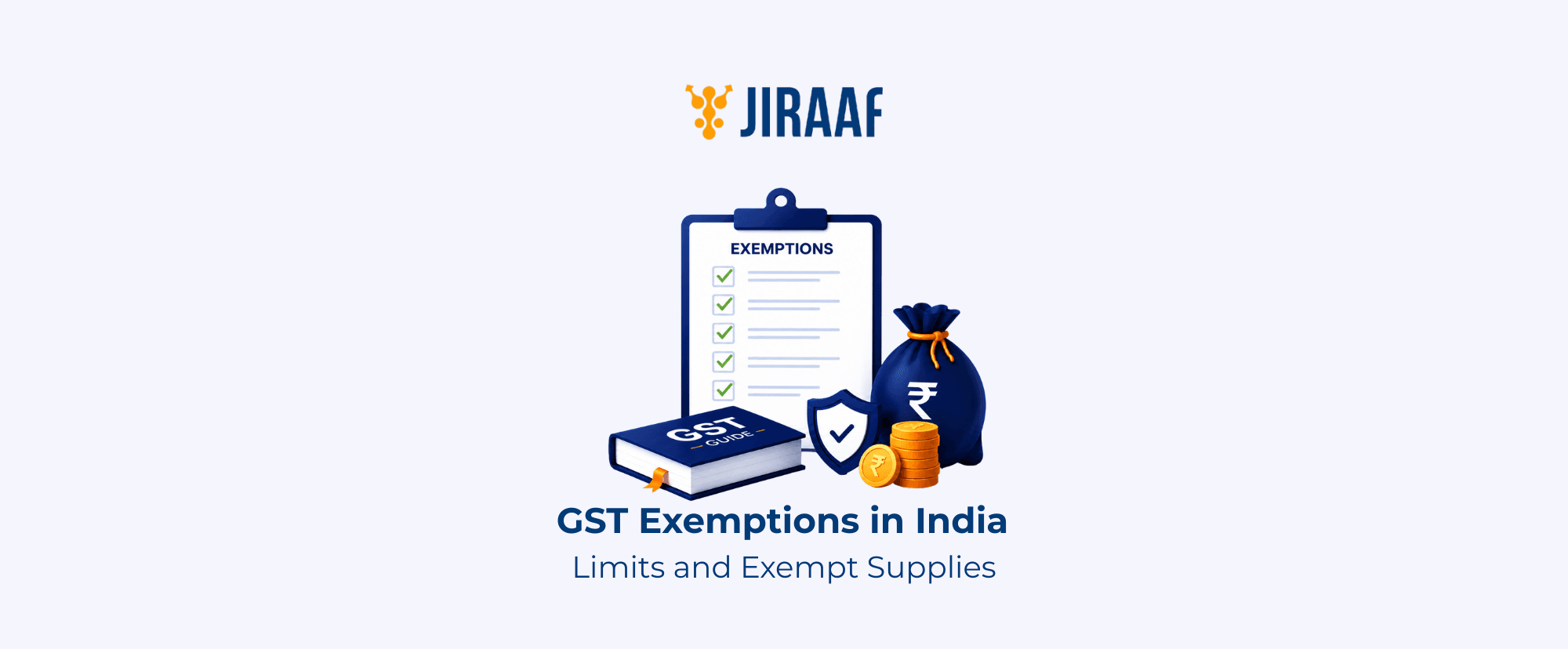
Summary: GST exemption means specified goods, services, or supplies are not subject to GST under applicable law or notifications. This guide explains exempt supplies, GST registration thresholds, common exempt goods and services, ITC treatment, and how to verify whether an exemption applies.
Quick Overview
- GST exemptions apply to specified goods, services or supplies covered by GST law or relevant notifications
- Exempt supplies broadly include nil-rated, wholly exempt and non-taxable supplies, while zero-rated supplies receive different treatment
- Individual life and health insurance premiums became GST-exempt from 22 September 2025
- The general registration threshold is ₹40 lakh for eligible exclusive goods suppliers and ₹20 lakh for service providers, subject to conditions
- ITC attributable exclusively to exempt supplies is generally not available, while common ITC may require proportionate treatment
- Always verify the HSN or SAC classification and the latest official notification before treating a supply as GST exempt
You’ve probably seen an invoice or bill of supply with no GST charged on it and assumed the business, or the product, is simply outside GST altogether.
However, a specific good or service can be exempt from GST regardless of the business’s type or turnover, while a business can separately qualify for exemption from GST registration if its turnover is less than the set threshold.
Not being clear about GST exemptions can lead to invoicing errors or a missed registration deadline. This blog covers what GST exemption actually means, and how it differs from a registration threshold.
What is GST Exemption?
The government exempts certain goods and services from GST to keep essential items affordable and support sectors such as healthcare, education, and agriculture. Under GST law, these exemptions are provided through Section 11 of the CGST Act and Section 6 of the IGST Act.
In simple terms, GST exemption means that a particular good, service, or category of supply is not subject to GST. An exempt supply includes goods or services attracting a nil GST rate, those wholly or partly exempt through a government notification, and non-taxable supplies such as alcohol for human consumption and specified petroleum products.
When a supply is exempt, the seller does not charge GST on it.
Some GST exemptions are conditional, depending on certain criteria mentioned in the notification. A common example is food grains. Unbranded, loose grains generally continue to be exempt, but the same product sold in a pre-packaged and pre-labeled form can attract GST. A similar condition applies to several food items, such as curd or vegetables, where the GST treatment changes when they are supplied in pre-packaged and pre-labeled form.
GST exemption on a supply is about the applicability of tax on that particular good or service. On the other hand, GST registration exemption is about whether your business needs to register with GST authorities based on turnover.
The first half of that distinction, exemption on a supply, is worth unpacking further, since exempt supply is itself a specific legal term.
What is an Exempt Supply Under GST?
An exempt supply is a broader legal category that groups three kinds of supplies: those attracting a nil GST rate, those wholly exempt under a notification, and those classified as non-taxable under GST law. All three share one practical outcome: the business does not charge GST on them.
Because no tax is charged, Input Tax Credit (ITC) attributable specifically to an exempt supply is generally not available to the seller. This becomes relevant for a business that deals in both taxable and exempt supplies.
If what you’re selling qualifies as an exempt supply, you cannot issue a regular GST tax invoice for it. GST law requires a bill of supply instead under Section 31(3)(c) of the CGST Act since a tax invoice implies tax has been charged, though a single ‘Invoice-cum-Bill of Supply’ is allowed under Rule 46A for mixed B2C sales. Getting this distinction right on your billing software or invoice format matters for compliance, since a tax invoice raised against an exempt item can draw scrutiny during a GST review.
Exempt vs Nil-Rated vs Zero-Rated vs Non-Taxable Supply
These four terms often get used interchangeably, but each carries a different ITC consequence.
| Type | Basic Meaning | GST Charged? | General ITC Position |
| Exempt supply | Supply covered by a GST exemption | No | ITC attributable to the exempt supply is generally restricted |
| Nil-rated | Supply attracting a 0%/nil GST rate | No | Legally mandatory to treat it as the exempt-supply framework for ITC purposes |
| Zero-rated | Specified supplies, such as exports and SEZ supplies | 0% treatment | No outward tax is paid (or tax paid is refunded), but ITC is fully allowed |
| Non-taxable supply | Supply not leviable to GST at all | No | Generally forms part of the exempt-supply concept |
Zero-rated should not be mistaken for a nil-rated or exempt supply. It applies exclusively to exports and supplies to Special Economic Zones (SEZs). It’s also the only 0% category where a business can actually claim a refund on the input tax credit tied to that supply, a benefit that GST-exempt, nil-rated, and non-taxable supplies don’t get.
GST Exemption List: Which Goods and Services are Exempt?
Most GST exemptions apply to essential goods, public welfare services, or sectors the government intends to support. On 22 September 2025, following the 56th GST Council meeting, several changes were made to the GST system. GST exemption expanded to certain goods, while GST rates also changed.
Common GST-exempt Goods
- Fresh, unprocessed food items such as fruits, vegetables, and fresh milk
- Food grains or pulses that are loose or packed on the spot for a consumer
- Specified agricultural produce and inputs used directly in cultivation
- Specified healthcare-related goods, such as human blood and its components, and contraceptives
- Specified educational materials, including printed books and newspapers
- Other notified essential goods, such as salt
Common GST-exempt Services
- Specified healthcare services provided by clinical establishments, doctors, and paramedics
- Specified educational services, generally limited to core school and recognized degree-level education, coaching and private test-prep services, are generally taxable, even though they sit in the same broad sector
- Certain agricultural services, such as cultivation, harvesting, and warehousing of produce
- Certain public transport services, such as metro rail, monorail, tramways, public inland waterways, and non-AC stage carriages
- Specified government and local-authority services
- Individual life and health insurance premiums, as of the September 2025 changes noted above
Not every service in these broad sectors is automatically exempt, and you must refer to the notice regarding specific services to clarify the exempt conditions.
What is the GST Exemption Limit?
GST registration threshold, which is incorrectly and commonly called the GST exemption limit, is not an exemption on the supply itself. It refers to the threshold beyond which a business must register for GST to operate legally in India.
GST registration is mandatory if the business’s annual turnover is higher than the following threshold limits:
- Exclusive goods suppliers: ₹40 lakh in most states, ₹20 lakh in special category states such as Uttarakhand and Meghalaya
- Service providers: ₹20 lakh in most states, ₹10 lakh in special category states, such as Manipur, Mizoram, Nagaland, and Tripura
It’s worth checking your specific state rather than assuming one number applies everywhere.
These thresholds also have exceptions that override them entirely. Certain activities require registration from the very first rupee of turnover, regardless of how small your business is. This includes businesses liable to pay tax under the Reverse Charge Mechanism (RCM) as recipients, those making interstate taxable outward supplies of goods, or specified persons selling through e-commerce platforms (though eligible intra-State goods suppliers are exempted subject to conditions).
A common beginner mistake is assuming exempt sales don’t count toward these limits. They do. Aggregate turnover is calculated on a pan-India basis under the same PAN, and it includes your exempt supplies along with taxable ones. Under Section 23(1)(a) of the CGST Act, a person engaged exclusively in supplying wholly exempt goods or services is exempt from GST registration regardless of turnover. A business selling exempt goods might still need to track the annual turnover carefully once taxable supplies, other activities, or locations enter the picture, even if no GST is ever charged on a single invoice.
How Does GST Exemption Affect Input Tax Credit?
Since no GST is charged on an exempt supply, the seller has no output tax to offset, which means ITC attributable exclusively to an exempt supply is generally not available.
It gets more layered once a business supplies both taxable and exempt goods or services from shared resources. Common inputs, like rent, utilities, or general overhead used across both types of sales, generally need proportionate treatment: only the share of ITC linked to the taxable portion can be claimed, and the rest has to be reversed.
Here’s a simple example. Suppose you run a bakery selling taxable cakes and exempt fresh bread. You claim full ITC on cake-specific boxes and zero ITC on bread packaging. For shared ingredients like flour and butter, you must pool the common credit and reverse a portion based on your monthly sales ratio.
Zero-rated supplies work differently, since exporters and SEZ suppliers can typically claim a refund on ITC even though the supply itself carries a 0% rate.
Whether a GST exemption applies depends on the applicable exemption, threshold limits, and ITC treatment.
How to Check Whether a Good or Service is GST Exempt
For every good or service sold, check against the following:
- Identify the exact good or service you’re evaluating, not the broad category it belongs to
- Find the applicable HSN code (for goods) or SAC (for services) tied to that specific item
- Check the current GST exemption notification for that HSN/SAC entry, rather than relying on an older summary of the GST exemption list
- Note whether the exemption is unconditional or conditional, and if conditional, whether your specific case meets the stated criteria around packaging, branding, or usage
- Confirm no recent amendment has changed the treatment, since notifications get superseded more often
The Central Board of Indirect Taxes and Customs (CBIC) portal remains the most reliable real-time source for checking HSN and SAC classifications against the current notification. Always check for the latest updates from official government sources and the GST portal.
Conclusion
The GST exemption framework continues to evolve as the government balances revenue collection with affordability and ease of compliance. Recent changes, such as the exemption for health and life insurance premiums, show how exemptions can be used to make essential services more accessible.
For consumers, understanding whether GST applies helps verify the accuracy of bills and avoid unnecessary charges. For businesses, staying updated on the latest exemption rules, GST rates, and registration requirements is essential for accurate invoicing, smooth Input Tax Credit (ITC) claims, and ongoing compliance. Since GST rules can change through notifications and Council decisions, reviewing the latest provisions before making business or tax decisions is always a good practice.