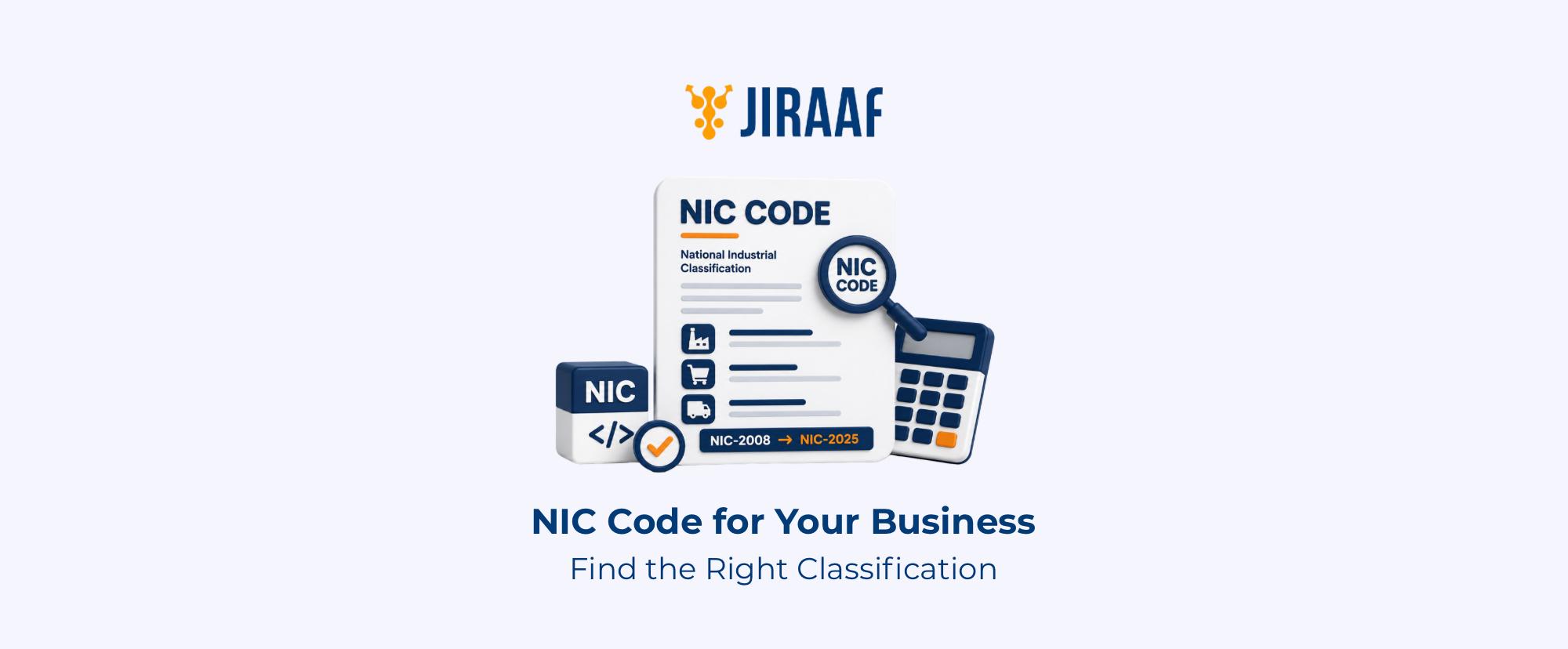
Summary: An NIC code classifies the main economic activity of a business using India’s National Industrial Classification system. This guide explains the NIC code list, NIC-2008 and NIC-2025, how to find the right code, add multiple business activities and update your Udyam registration.
Quick Overview
- An NIC code classifies the economic activity carried out by a business
- The right code depends on what the business actually does, not simply its name
- NIC-2008 and NIC-2025 use different classification structures, so check which version the relevant portal requires
- You can search the official NIC classification system using a clear description of your business activity
- One Udyam registration can include multiple business activities with a primary and secondary classification
- You should review and update NIC codes when your business activities change
You’re filling out your Udyam registration form and hit a field labeled “NIC Code”. Your business doesn’t have one. You search online and find conflicting guides. Some mention NIC-2008, others reference NIC-2025.
This confusion costs time, and wrong codes delay approvals or disqualify you from specific MSME benefits.
The NIC code is your business’s statistical identity in India’s economy. It describes what you actually do, the daily economic activity that generates your revenue, not your company’s legal structure, name, or location. Getting it right helps ensure your business is classified accurately, which can matter when a scheme, application, or lender’s eligibility conditions depend on your registered activity.
This guide walks you through finding the exact code for your business, understanding why the government changed codes in 2025, and learning what happens when you register with the wrong one.
What is an NIC Code and Why Does Your Business Need One?
NIC stands for National Industrial Classification. It’s a five-digit number under NIC-2008, or a six-digit number under the newer NIC-2025, that the Ministry of Statistics and Programme Implementation uses to classify the economic activities across India. Instead of assigning a unique number to your specific business, the government provides this standard framework so you can select the specific code that matches your economic activities across India.
Udyam registration, MCA company incorporation, and some bank loan applications all ask for your NIC code. The government also uses it to count how many micro-businesses operate in retail, how many in manufacturing, and how many in services.
A person running a garment boutique and a person manufacturing readymade clothes have completely different NIC codes, even though both work in “apparel”. The boutique owner buys finished clothes and resells them (retail code); the manufacturer buys fabric and produces garments (manufacturing code). The system distinguishes between these because they involve different economic activities, which can also matter where a scheme has activity-specific eligibility conditions.
To find the right NIC code, you must understand the classification first.
How the NIC Classification Works
The NIC system uses a hierarchical structure that drills from broad economic sectors down to your exact activity. The hierarchy, standard 5 levels under NIC-2008, is:
- Section (alphabetical): The broadest category. Section C is all manufacturing, Section G is all wholesale and retail trade. There are 21 sections total, labeled A through U.
- Division (2 digits): Narrows within the section. Division 47 means retail trade.
- Group (3 digits): Further specificity. Group 471 is retail sales in non-specialized stores, like kirana shops.
- Class (4 digits): Closer still. Class 4711 is retail sales of food, beverages, or tobacco in non-specialized stores.
- Sub-class (5 digits): Your final, most specific code. 47110 is “Retail sale in non-specialized stores with food, beverages or tobacco predominating”.
For a kirana shop selling groceries, snacks, and daily household items, that’s Section G, Division 47, Group 471, Class 4711, Sub-class 47110, your final code.
Under the updated NIC-2025 architecture, this expands into a 6-digit code for modern specialized niches.
NIC-2008 vs NIC-2025: Understanding the Big Shift
For 17 years, India used NIC-2008. On November 18, 2025, the Ministry of Statistics released NIC-2025, a complete overhaul reflecting how India’s economy has changed since. Fintech, e-commerce, cloud computing, blockchain, and digital aggregators like food delivery and ride-sharing have all grown into distinct, large-scale sectors that the older classification didn’t separately track. AYUSH (traditional Indian medicine systems) and handloom production existed too, but weren’t formally captured either. NIC-2025 gives many of these their own dedicated codes.
NIC-2025 expanded from 5-digit codes (1,304 possible sub-classes) to 6-digit codes (1,887 possible sub-classes), letting the government distinguish between more granular activities, including
- Fintech and digital financial services (previously lumped into generic finance)
- Cloud infrastructure and data hosting (previously under “computer services”)
- Food and logistics aggregators (delivery platforms, ride-sharing hubs)
- Blockchain and cryptocurrency services
- E-commerce platform management
- AYUSH practitioners and wellness services, and
- Handloom and artisan production.
While the Ministry released NIC-2025 in November 2025, the Udyam portal, MCA corporate registration, and GSTN all transitioned in phased cycles. As of August 2026, the live Udyam registration portal still asks for NIC-2008 codes, and MCA corporate incorporation continues to reference NIC-2008 as of this writing too.
Use the version your specific portal asks for on that day. Look at the form itself; if it shows NIC-2008, use that; if it shows NIC-2025, use the newer codes.
You can search for an NIC code that matches your business activity using official government search tools.
Step-by-Step: How to Find Your Right Business Code Online
To find the right NIC code, avoid the jargon. Instead of “retail enterprise”, write “I buy readymade clothes from suppliers and sell them in my shop”. Government search tools are now designed to understand plain language.
- Search on the official government lookup tool: Visit the official National Industrial Classification finder run by the Ministry of Statistics. Type your plain-English description. The tool returns matching NIC codes with full descriptions.
- Use local language support: The newer government search tools support conversational language and regional Indian languages, such as Hindi, Tamil, Telugu, Marathi, and others. The system maps regional terms directly to official codes.
- Drill down to the final subclass: The search tool will show you the full hierarchy. Don’t stop at a division or group. Read the complete 5-digit (or 6-digit) sub-class description and confirm it exactly matches your actual daily work.
NIC Code List: Quick Reference for Common Indian Businesses
Here’s a lookup table for the most common MSME activities. Use this as a starting point, but always verify with the official portal because your specific operation might have nuances.
| Business Type / Target Search | Core Operational Activity | NIC-2008 Code (Current Form) | NIC-2025 Code (New System) | Hierarchy Pathway |
| Kirana store | Retail sale of groceries, snacks, and daily-use items | 47110 | 471100 | G → 47 → 471 → 4711 |
| Readymade garment boutique | Retail sale of finished, branded clothes | 47711 | 477101 | G → 47 → 477 → 4771 |
| Tailoring shop | Custom tailoring of garments | 14105 | 141006 | C → 14 → 141 → 1410 |
| Beauty parlor/salon | Hairdressing and parlor services | 96020 | 962100 | S → 96 → 962 → 9621 |
| Beauty parlor/salon | Beauty treatment services | 96020 | 962201 | S → 96 → 962 → 9622 |
| Restaurant/cafe | Preparation and immediate serving of food | 56101 | 561001 | I → 56 → 561 → 5610 |
| Cloud kitchen | Preparation of food for delivery and other commercial purposes | 56102* | 561005 | I → 56 → 561 → 5610 |
| Bakery | Manufacture of bread, biscuits, cakes, pastries and other bakery products | 10711 / 10712 / 10719† | 107101 / 107102 / 107103 / 107199† | C → 10 → 107 → 1071 |
| E-commerce brand (D2C) | Retail sale of own products through online channels | 47912* | Activity-specific under NIC-2025‡ | G → 47 → relevant retail class |
| Mobile shop/electronics | Retail sale of mobile phones, smartphones and related accessories | 47414 | 474004 | G → 47 → 474 → 4741 |
| Furniture enterprise | Manufacture of wooden or metal furniture | 31001 | 310101 | C → 31 → 310 → 3101 |
| Jewelry showroom | Retail sale of jewellery and imitation jewellery | 47733 | 477303 | G → 47 → 477 → 4773 |
| Poultry farm | Raising and breeding poultry | 01461 | 014601 | A → 01 → 014 → 0146 |
| Poultry farm | Production of eggs | 01462 | 014602 | A → 01 → 014 → 0146 |
| Wholesale trading | Bulk wholesale trade via physical or digital channels | 46909 | 469000 | G → 46 → 469 → 4690 |
| Transport & logistics | Road freight transport and local cargo handling | 49231 | 492301 | H → 49 → 492 → 4923 |
Notes
- Cloud kitchen: NIC-2008 had no dedicated cloud-kitchen code; 56102 was the closest practical fit. NIC-2025 specifically classifies cloud kitchens under 561005.
- Bakery: NIC-2008 uses 10711 for bread, 10712 for biscuits, cakes, pastries and rusks, and 10719 for other bakery products. NIC-2025 similarly uses multiple codes based on the product.
- E-commerce/D2C: NIC-2008 included 47912 for retail sales via e-commerce. NIC-2025 uses activity-specific codes rather than a single generic online-retail code.
- Beauty Parlor/Salon: NIC-2025 separately classifies hairdressing (962100) and beauty treatment (962201); businesses offering both may need multiple codes.
- Poultry: NIC-2025 separately classifies poultry rearing/breeding (014601) and egg production (014602).
- Transport & Logistics: 492301 covers motorized road freight transport; cargo handling is classified separately.
Identifying the right code is one step toward positioning your business for relevant bank credit lines and government funding schemes.
Why Choosing the Right NIC Code Still Matters
Your NIC code identifies the economic activity your enterprise carries out and can be relevant to your eligibility for certain government benefits. It doesn’t determine eligibility on its own, though; each scheme has its own conditions. A tailoring shop correctly registered under a manufacturing code, for instance, is better positioned for capital subsidies tied to machinery purchases, where such schemes exist. A retail shop using a mismatched description may face extra scrutiny or delays if its operations don’t match its certificate.
How the Right NIC Code Supports MSME Bank Loans and Subsidies
Accurate NIC classification helps banks and government authorities verify that your business’s actual activities align with the requirements of sector-specific credit schemes or subsidies. Keeping your code consistent with your daily operations can make loan evaluations and scheme approvals go more smoothly, since it reduces the chance of a mismatch between what your certificate states and what you actually do.
Registering Multiple Business Activities Under One Udyam
Udyam allows only one registration per enterprise, but that single registration can include multiple NIC codes covering the different activities of the enterprise, up to 10 in total, one primary and up to nine secondary.
You must select one Primary Activity, which represents the main activity of the enterprise. Other activities can be listed as Secondary Activities. For example, if your business carries out both retail garment sales and tailoring services, you can list the relevant NIC codes for both activities under the same Udyam registration. The primary and secondary classifications can matter where a particular government scheme or procurement process uses activity-specific eligibility criteria.
If your enterprise starts a new activity or stops carrying out an existing one, you may need to update your Udyam registration to reflect the change.
How to Change or Update Your NIC Code on an Existing Udyam Certificate
While Udyam pulls financial data automatically from ITR and GST-linked government databases, changing your business activity requires you to update your registration details online. Udyam allows you to add or modify activities, including their NIC codes, under your existing registration.
- Go to the official udyamregistration.gov.in portal and select the Udyami Login option
- Enter your Udyam Registration Number and registered mobile number, then choose to receive an OTP on your mobile or email
- Once logged in, go to the section covering your registered business activities
- Add or modify the relevant NIC code(s) as needed
- Submit the changes
Your existing Udyam Registration Number remains unchanged. The updated details are reflected in the Udyam system, allowing the current activity information to be checked against your registration online.
Common Errors to Avoid When Choosing Your NIC Code
Here are some mistakes you must avoid when selecting the right NIC code:
- Confusing NIC with HSN/SAC codes: NIC codes classify the economic activities of an enterprise. HSN codes classify goods, while SAC codes classify services for GST purposes. A kirana business may have one or more relevant NIC codes, while the products it sells have their own HSN codes.
- Choosing by company name keywords: Don’t choose a code based on your business name. The code depends on what operations you carry out for your business.
- Using outdated lists: The official NIC Finder currently allows searches under both NIC-2025 and NIC-2008, so check which classification your particular registration or application requires before selecting a code.
- Misclassifying manufacturing vs retail: Manufacturing activities fall under Section C, while wholesale and retail trade fall under Section G. If your enterprise manufactures goods, select the relevant manufacturing activity; if it purchases finished goods for resale, select the applicable wholesale or retail activity.
Conclusion
The NIC-2008-to-NIC-2025 transition is still unfolding. Udyam and MCA registration both continue to run on NIC-2008 for now, but that won’t stay true indefinitely, and the code you register today may need rechecking once a portal you use makes the switch. If you’re unsure between two codes, contact a Chartered Accountant or add both under your registration and select the one that represents your main activity as primary.
The code you choose shapes how the government counts your sector in its economic data, and an accurate classification keeps your registration consistent with schemes and applications where your activity is relevant. Getting it wrong doesn’t automatically disqualify you from anything, but it can create inconsistencies worth avoiding from the start.