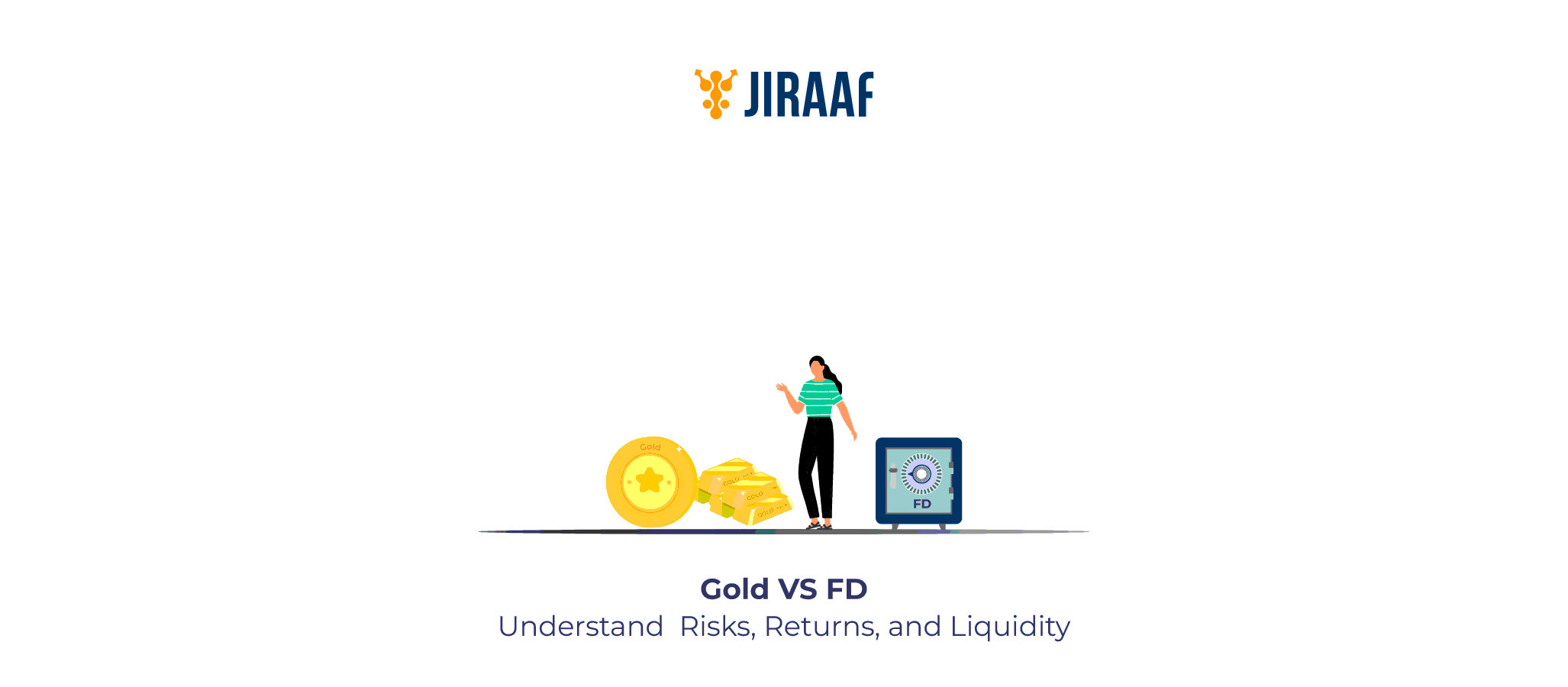
FDs and savings accounts are found in every financial toolkit. Most people begin investing with these, but which one is a good fit for your portfolio? This blog discusses their differences across various parameters to help you choose the one that’s best for you.
Many people treat saving money as a single act: earn it, set it aside, and consider the job done. But where that money actually sits matters more than some people realize. The difference between a savings account and a fixed deposit is not just a matter of paperwork or personal preference. It shapes how much your money earns, how quickly you can get it back, and how much of it the government taxes. These are not small distinctions, and when compounded over months and years, they can quietly add up to a meaningful amount.
The question, then, is where to save.
Now, both options are among the safest financial instruments available in the market. Neither exposes you to stock market swings or the complexity of mutual funds. They are straightforward, bank-backed, and widely understood. But underneath that shared simplicity, they are built on very different ideas about what your money should be doing while it sits in your account. Understanding that difference is what turns this from a guessing game into a clear-headed decision.
Fixed Deposit vs Savings Account: The Core Difference
A savings account is built for movement. It supports frequent deposits, withdrawals, and day-to-day transactions through UPI, ATMs, and net banking.
A fixed deposit, on the other hand, works on the opposite principle: you lock in a lump sum for a fixed tenure, from 7 days up to 10 years, in return for assured returns. That trade-off between flexibility and commitment drives every other distinction between the two.
And the first place it shows up is in interest.
Interest Rates: Why do FDs Pay More?
The most glaring difference between these two is the Return on Investment (ROI). Fixed deposits typically offer interest rates 2% to 4% higher than those of savings accounts because the bank can use that money predictably over the chosen period.
Savings accounts, on the other hand, remain withdrawable at all times, which limits how aggressively banks can reward them. Traditional savings rates usually stay between 2.5% and 4%, even though some neo-banks may offer competitive alternatives.
One key advantage of FDs is certainty; once you book a rate, it stays locked even if market rates fall later. Savings rates do not carry that stability.
But these higher FD returns come with reduced access.
Liquidity & Access: Convenience vs Commitment
Savings accounts offer you complete liquidity; your funds remain available instantly, whether for emergencies or everyday spending.
FDs are less flexible than savings accounts. Premature withdrawals are possible, but they usually reduce your interest by 0.5% to 1%. Certain tax-saver FDs go further, carrying a mandatory 5-year lock-in where withdrawals aren’t allowed at all.
So, while an FD may grow your money faster, a savings account keeps it usable. Tax treatment is the next factor that often gets overlooked.
Tax Implications: What Does the Government Take?
Don’t let the “guaranteed returns” fool you; both these assets incur taxes.
For savings accounts, under Section 80TTA of the Income Tax Act, interest earned up to ₹10,000 per year is tax-exempt for individuals under 60 years of age. For senior citizens, Section 80TTB increases this limit to ₹50,000 (covering both savings and FD interest).
On fixed deposits, interest is fully taxable based on your income tax slab. If your interest income exceeds ₹40,000 (₹50,000 for seniors) in a financial year, the bank will deduct Tax Deducted at Source (TDS) at 10%.
This difference matters most when you hold large balances for extended periods. So, when does each option make sense?
When FDs Make More Sense
FDs work best when the money is meant to stay untouched for at least 6–12 months.
They are especially useful for planned goals like a house down payment or a wedding fund, where discipline matters as much as returns. They also appeal to risk-averse investors who want capital stability without market fluctuations.
Senior citizens often benefit further, as banks typically offer them an additional 0.50% interest, making FDs a dependable source of income. Still, not all money should be locked away.
When a Savings Account Might Be the Better Choice
Savings accounts are most valuable when access matters more than yield.
Emergency funds belong here because penalties and delays defeat the purpose of financial readiness. They also remain the natural choice for monthly expenses like rent, utilities, groceries, and routine spending.
Also, if you’re waiting to deploy money into another opportunity, liquidity becomes more important than locking into a fixed return.
To simplify the comparison, here’s the snapshot view.
Summary Table: Fixed Deposit vs Savings Account
| Feature | Savings Account | Fixed Deposit |
| Returns | Lower, variable | Higher, fixed, and guaranteed |
| Liquidity | Anytime access | Penalty on early withdrawal |
| Risk | Negligible | Negligible |
| Tenure | No fixed term | 7 days to 10 years |
| Tax treatment | Exempt up to ₹10,000 (Section 80TTA) | Fully taxable; TDS above ₹40,000 |
| Best suited for | Emergency funds and daily expenses | Goal-based savings and surplus cash |
Final Verdict
A strong financial setup doesn’t force a choice between FDs and Savings accounts; it assigns each a role.
You can use your savings account for stability and access, and FDs to park surplus money that needs protection, structure, and better guaranteed growth. When these assets are combined correctly, you get both liquidity and returns without compromise.
The instinct to pick one over the other is understandable. It feels tidier, more decisive. But it might not be the best decision for you. A savings account and a fixed deposit are not rivals competing for the same role. They are built to do different jobs, and the smartest thing you can do is let each one do its job well.