Explore how different bond strategies can help you plan your income and manage expenses more effectively.
Mr. Financewala is in his room, laptop in his lap, scrolling through the Excel sheet where he tracks his fixed expenses:
| Family Member | Expense Type | Amount/Details |
| Couponkumar (son) | School fees | ₹7,000 per month |
| Cashflowika (daughter) | Art class fee | ₹2,500 per month |
| Mrs. Expensevati (wife) | Shopping spree | ₹15,000 every three months |
The numbers are familiar. They show up like clockwork, every single month and every single quarter, without fail.
What has changed is how Mr. Financewala looks at them now. After spending weeks understanding how bonds work, Mr. Financewala now feels confident that, with the right structure, he can use bond coupons to automate a part of his expenses.
Previously, we discussed the process required for Mr. Financewala to buy and sell bonds in India. In this chapter, we will discuss how he can strategically buy and sell bonds to cover his planned expenses.
What is the Role of Bonds in a Portfolio?
Bonds help investors like you by offering a path to diversification and a way to achieve stable wealth creation.
- Helps in goal-based investing
Every investor, including you, may have expenses they can see coming, such as their child’s school fees due in the next month, a family holiday planned in the month after or even a long-term fixed expense like a home down payment due in 5 years from now. Bonds, with their fixed tenors and predictable payouts, can be invested in a way that directly matches these timelines.
- Delivers salary-like income
A bond with monthly or quarterly interest payouts can function almost like a second salary, offering a fixed return that arrives on a schedule and does not depend on market conditions. For investors building passive income streams, this predictability is a lucrative feature.
- Offers a middle ground between FD and equity
Traditional fixed deposits are safe, but their post-tax returns rarely beat inflation. On the other hand, equities can deliver higher returns comparatively but are more volatile.
Bonds can help balance this trade-off by potentially offering returns that are higher than FDs while offering stability so you can receive fixed returns without worrying about the markets every morning.
Now that the role of bonds is clear, the next step is to understand which types of bonds investors can hold in their portfolios based on their risk appetite.
Ideal Bonds to Invest in Based on Investor Risk Profile
| Bond Credit Rating | Issuers | Suitable Investor Profile |
| AAA | Primarily issued by PSUs, government-backed entities, and large, financially strong private corporations | Extremely conservative investors who prioritise capital preservation above all else and have very low risk tolerance |
| AA+ / AA / AA- | Issued by governments, public companies, large blue-chip companies and well-established NBFCs | Moderately conservative investors seeking stable returns with minimal credit risk |
| A+ / A / A- | Public companies and private companies | Investors aiming for relatively higher yields while still maintaining a controlled level of risk |
| BBB+ / BBB / BBB- | Emerging corporates and mid-sized NBFCs | Investors willing to take on slightly higher credit risk in exchange for improved yields, with a balanced risk-return approach |
Note: Bonds rated below BBB – are considered junk bonds. A 2025 CRISIL report highlights that default rates increase sharply for bonds starting from BB+ credit rating, making them significantly riskier compared to investment-grade bonds.
However, the bigger question is how to combine bonds in a way that aligns with their expenses and timelines.
Common Bond Strategies Explained
The following are the most common bond strategies deployed by investors to manage their short- and long-term expenses.
Bond Laddering Strategy Explained
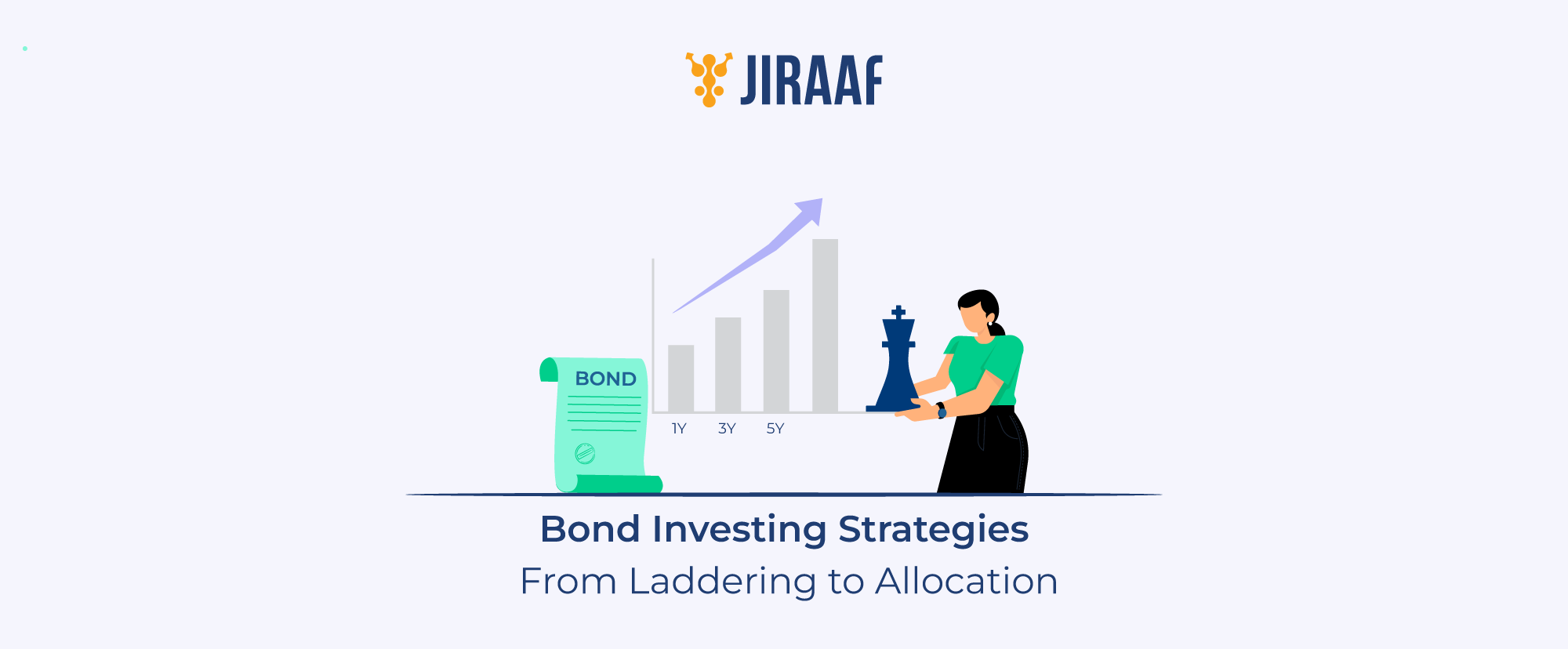
A bond ladder is a fixed-return strategy where you spread your investments across multiple bonds with different maturity periods. This way, you create a structure where money flows back to you at regular and pre-planned intervals.
For Mr. Financewala, this strategy directly answers his spreadsheet problem.
Assume Mr. Financewala has ₹6,00,000 to invest. He decides to build a five-rung ladder, allocating ₹1,20,000 to each bond across five different maturity periods.
| Year | Bond Type | (YTM) | Allocation (₹) | Annual Interest Earned (Approx.) |
| 1 | Short-term G-Secs & High-Quality Corporate Bonds | 8% to 10% | ₹1,20,000 | ₹9,600 to ₹12,000 |
| 2 | A and BBB rated Corporate Bonds | 12% to 14% | ₹1,20,000 | ₹14,400 to ₹16,800 |
| 3 | AA and A rated Corporate Bonds | 11% to 13% | ₹1,20,000 | ₹13,200 to ₹15,600 |
| 4 | AAA and AA rated Corporate Bonds | 9% to 11% | ₹1,20,000 | ₹10,800 to ₹13,200 |
| 5 | PSU Bonds & AAA rated Instruments | 7% to 9% | ₹1,20,000 | ₹8,400 to ₹10,800 |
Note: The expected return (YTM) is based on generalized expectations of how similarly credit-rated bonds have historically generated returns.
Now, here is how each rung maps to Mr. Financewala’s actual expenses, with the returns for each rung based on the above-assumed YTM percentages
Year 1: The ₹1,20,000 in short-term bonds generates ₹9,600 to ₹12,000 annually in interest. Paid out monthly, this comes to roughly ₹800 to ₹1,000 per month, which can be a contribution toward Master Couponkumar’s ₹7,000 monthly school fees.
Year 2: The ₹1,20,000 in A and BBB rated bonds earns ₹14,400 to ₹16,800 annually. Paid quarterly, each payout is approximately ₹3,600 to ₹4,200. This directly contributes toward Miss Cashflowika’s quarterly art class invoices and Mrs. Expensevati’s ₹15,000 quarterly shopping budget.
Year 3: The ₹1,20,000 in AA and A rated bonds generates ₹13,200 to ₹15,600 annually. This tranche balances credit quality with a strong yield, providing a reliable middle layer of the ladder that contributes steadily to the monthly expense pool.
Year 4: The ₹1,20,000 in AAA and AA rated bonds delivers ₹10,800 to ₹13,200 per year with high credit safety. At this point in the ladder, capital preservation takes priority while still contributing meaningfully to the overall interest income.
Year 5: The ₹1,20,000 in PSU and AAA rated instruments earns ₹8,400 to ₹10,800 annually. It anchors the portfolio with near-zero default risk and ensures that even in a difficult market environment, at least one portion of the ladder continues paying reliably.
When the Year 1 bond matures, Mr. Financewala can take the ₹1,20,000 principal and reinvest it into a new five-year bond at the far end of the ladder. The following year, the Year 2 bond matures, and he can do the same so that the ladder never runs out and keeps generating interest income to cover his recurring expenses while continuously refreshing itself with new bonds.
Note: While the above example fails to cover Mr. Financewala’s full expenses, it helps to understand a broader idea of how deploying a bond ladder can take care of your expenses fully or partially.
Also, the bond ladder works well for covering recurring expenses, but Mr. Financewala may not always want to spread his investments across multiple timeframes.
Barbell Strategy in Bonds
The barbell strategy takes a different approach. Instead of spreading investments in five different maturity periods, it concentrates investments at just two extremes: the short-term bonds and the long-term bonds.
Here is how it would look if Mr. Financewala deployed a with barbell bond strategy with ₹6,00,000.
| Maturity Bucket | Bond Type | YTM | Allocation |
| Short-term (1–2 years) | G-Secs / AAA rated bonds | 7% to 9% | ₹3,00,000 |
| Long-term (7–10 years) | A / AA / BBB rated bonds | 11% to 14% | ₹3,00,000 |
Note: The expected return (YTM) is based on generalized expectations of how similarly credit-rated bonds have historically generated returns.
The short end leg of the strategy will generate approximately ₹21,000 to 27,000 annually based on the above-assumed YTM percentages. These bonds will mature every one to three years, with principal returned at regular intervals. Each time a short-term bond matures, Mr. Financewala has to either reinvest at the prevailing rate by keeping the ladder rolling or redirect the principal to his planned expense.
On the other hand, the long end of this strategy will generate ₹33,000 to ₹42,000 annually. These bonds will be untouched for seven to ten years at least, locking in higher yields. This leg quietly compounds Mr. Financewala’s income stream while the short-term bonds handle near-term expenses.
But what if his goal wasn’t to manage ongoing expenses, but to prepare for one large expense at a specific point in time?
Bullet Strategy in Bonds
A bullet strategy would involve Mr. Financewala investing his capital into multiple bonds that all mature around the same date.
Here’s how Mr. Financewala will have to execute a bullet strategy
| Year of Investment | Bond Type | Expected Yield (YTM) | Maturity (Aligned) |
| Year 1 | AA rated bonds | 10% to 11% | Year 5 |
| Year 2 | A rated bonds | 11% to 12% | Year 5 |
| Year 3 | AA / AAA bonds | 9% to 10% | Year 5 |
| Year 4 | AAA bonds | 8% to 9% | Year 5 |
| Year 5 | Short-term bonds | 7% to 8% | Year 5 |
The goal of this strategy is to have a large, precise lump-sum corpus available at a specific time in the future to cover a major expense, such as buying a house or a car.
Conclusion
From understanding what bonds are to actually using them to plan his expenses, Mr. Financewala’s journey shows how structured learning can turn a complex concept into something practical and usable. What started as curiosity gradually became clarity, and then action.
With that, we wrap up Mr. Financewala’s journey here. But if you’ve followed along this far, there’s one more step left.
In the next chapter and final chapter of our bond series, we explore a few advanced bond concepts that help you better understand market movements and news headlines, so you will never feel left out when reading about bonds.