Quick Overview
Summary: Bonds are debt instruments that provide investors with fixed returns and portfolio stability. This guide explores the different types of bonds, including government, corporate, and specialized options like callable, puttable, and convertible bonds.
- Bonds represent loans that the bond issuer obtains from investors. The issuer offers the investor regular interest and repays the principal at maturity
- Bonds can be classified by issuer, return structure, tax treatment, and maturity, and each category carries a different risk, yield, and liquidity profile
- Most bonds generate periodic income, while capital outcomes depend on interest rate movements and issuer credit quality
- Zero-coupon bonds do not pay interest but are issued at a discount and redeemed at face value
- Understanding the differences between bond types helps investors match the right instrument to their risk profile, tax situation, and investment horizon
Not all bonds work the same way. Some pay fixed coupons while others pay nothing until maturity and are bought at a discount. Some bonds have a sovereign guarantee while others offer a higher yield for taking on credit risk.
The category a bond falls into determines its risk profile, how it pays returns, what tax treatment applies, and how it matches an investor’s financial goals.
This guide gives clarity on the various types of bonds classified by issuer, return structure, tax treatment, and maturity.
Understanding the 2026 Indian Bond Market
India’s bond market in 2026 stands at a pivotal crossroads, shaped by regulatory reforms and evolving macroeconomic dynamics. For investors new to fixed income, understanding this landscape is important, not only for enhancing returns but also for managing risk in an era of changing policies and innovative financial instruments.
At its core, a bond is a contract between a borrower (debtor) and a lender (creditor/investor), where the borrower promises to repay the principal to the investor with agreed-upon interest. In India, bonds serve as essential instruments for governments and corporations to raise funds and for investors to access a range of risk and reward profiles, liquidity, and tax benefits.
Types of Bonds by Issuer: Safety and Credit Profile Explained
When evaluating bond investments, the first question is: who is borrowing the money, and how safe is the principal? Here are some bonds classified based on the issuer’s credit profile.
Sovereign Bonds (G-Secs and Treasury Bills)
G-secs and treasury bills are issued by the RBI on behalf of the central government and are considered one of the safest investments, carrying virtually very low-to-no default risk. In 2026, these are highly liquid due to India’s inclusion in global bond indices.
Example: Government of India 7.26% GS 2029, and Government of India 7.18% GS 2033
State Development Loans (SDLs)
Issued by state governments, SDLs offer a small yield premium over G-Secs.
Example: Maharashtra SDL 2032
Public Sector Undertaking (PSU) Bonds
PSU bonds are issued by significant government-backed entities like REC Limited or NABARD and are highly rated due to their government ownership.
Example: REC Ltd 7.25% 2027 bonds
Corporate Debentures
Issued by private sector companies, corporate bonds come in investment-grade (AAA to BBB-) and high-yield (junk) categories.
Investment-grade examples include HDFC Bank AAA-rated NCDs, while high-yield examples include historical IL&FS debentures.
Each of these bond classes offers a different balance of safety, yield, and risk, with government-backed bonds being the most secure and corporate debentures offering higher returns for higher risk.
How Bonds Pay Returns: Fixed, Floating, and Other Interest Structures
The way a bond pays returns is another key consideration for investors. Here are some bonds categorized on the basis of returns.
Fixed-rate Bonds
Fixed-rate bonds pay a constant interest rate throughout their tenure.
Example: Indian Railways Finance Corporation (IRFC) tax-free bonds (traded on the secondary market)
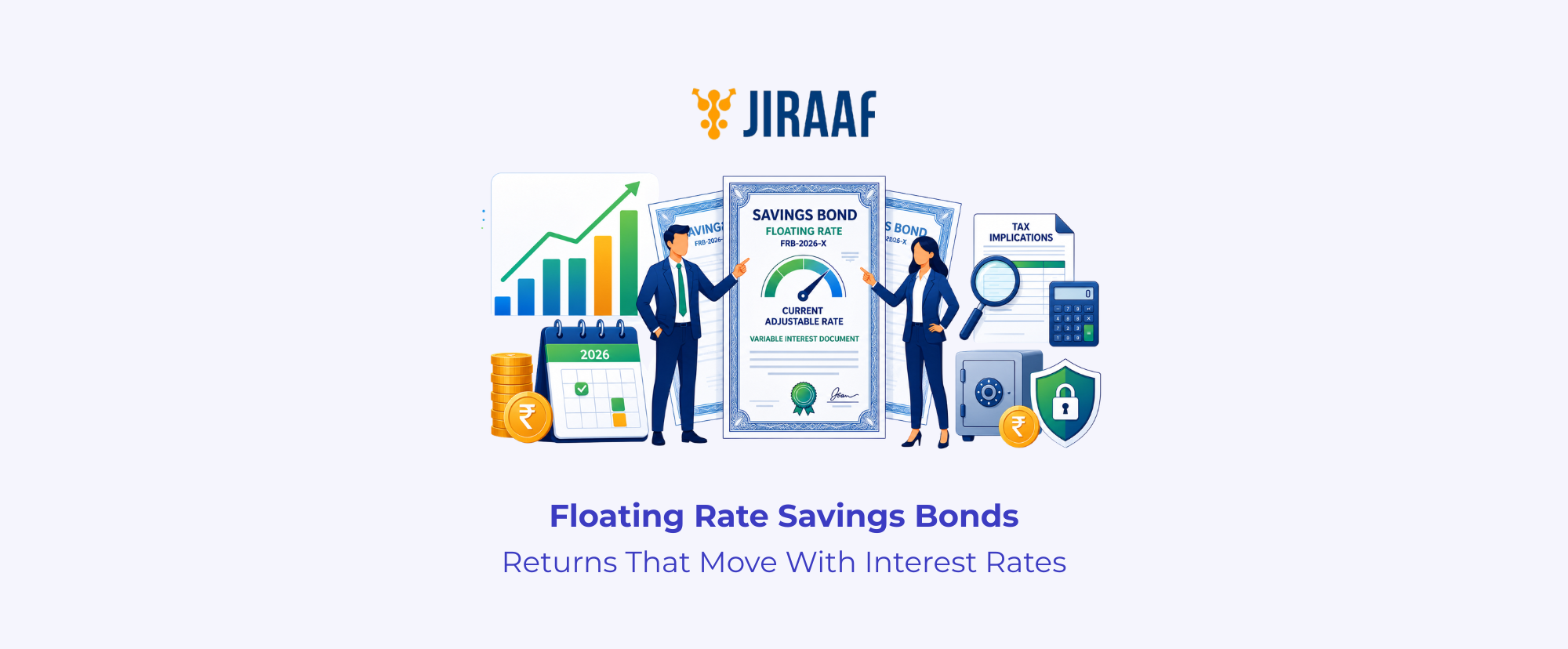
Floating Rate Savings Bonds (FRSB)
The interest rate on FRSBs is linked to a benchmark, currently the National Savings Certificate (NSC) rate, and stands at 8.05% in 2026.
Example: RBI Floating Rate Savings Bond 2026 (taxable)
Zero-coupon Bonds (ZCBs)
Issued at a discount, zero-coupon bonds do not pay periodic interest. The investor receives the face value at maturity.
Example: IDFC zero-coupon bonds, or NABARD zero-coupon bonds
Inflation-indexed Bonds
Inflation-indexed bonds adjust returns to the Consumer Price Index (CPI), protecting purchasing power. While rare in primary issuance in 2026, they remain a key theoretical hedge.
Example: RBI Inflation-indexed bonds (2013–2018 series)
Tax Benefits and Regulations for Indian Bonds in 2026
Taxation can significantly impact net returns. In 2026, the recodified Income Tax Act brings key provisions for bond investors:
Section 85 Capital Gain Bonds
Section 85 bonds (formerly 54EC) are designed for reinvesting long-term capital gains from the sale of land or buildings. They offer 5.25% interest, a five-year lock-in period, and a ₹50 lakh annual investment limit. To claim the exemption, the investment must be made within six months of the asset sale.
Example: REC and PFC Section 85 bonds
Tax-free Bonds
Interest on tax-free bonds is exempt under Section 10(15). Most are available only on the secondary market, as new issuances are rare.
Example: PFC, NHAI, and IRFC tax-free bonds issued before 2016
Sovereign Gold Bonds (SGBs)
SGBs pay 2.5% annual interest (taxable), and capital gains are tax-free if held to maturity. These are currently not being issued, but the existing issuances can be traded in the secondary market.
Example: RBI Sovereign Gold Bond Series 2023-24
Assessing Bond Risks and Liquidity: What Investors Need to Know
Investors must consider three primary risks: interest rate risk, credit (default) risk, and liquidity. Here is a comparative look at key bond categories:
| Bond Category | Interest Rate Risk | Credit (Default) Risk | Liquidity | Examples |
| G-Secs | High (long duration) | Sovereign guarantee (None) | High (RBI Retail Direct) | 7.26% GS 2029 |
| Corporate (AAA) | Moderate | Very low | Moderate (NSE/BSE) | HDFC Bank |
| Section 85 Bonds | Low (fixed) | Very low (PSU) | Zero (mandatory 5-year lock-in) | REC/NHAI |
| Perpetual (AT1) | Moderate | Higher (write-down risk) | Low (mainly institutional) | SBI AT1 bonds |
| T-Bills | Very low | Sovereign (none) | High | 91-day treasury bills |
Short-term vs. Long-term Bonds and Optional Features
Bond investments also vary by maturity and special features.
Short-term (Money Market Instruments)
Instruments like Treasury bills (T-Bills) and commercial paper (CP) mature in less than a year.
Examples: 91-day T-Bills, large NBFC CPs
Long-term (Dated Securities)
These range in tenure from two to forty years.
Example: Government of India 2064 bond (40-year G-Sec)
Callable/Puttable Bonds
These carry embedded options for early redemption, either by the issuer (callable) or the investor (puttable). In the 2026 high-liquidity market, these are increasingly used by banks to manage Tier-1 capital.
Examples: SBI callable bonds, NHB puttable bonds
How Investors Could Choose Bonds in 2026
Selecting bonds in 2026 is less about chasing returns and more about aligning investments with financial goals and risk appetite. Most experts recommend mapping bond choices to risk profile, such as risk-averse, balanced, or growth-oriented. Matching the bond’s duration to one’s investment horizon and always checking the credit rating migration for corporate issuers helps make better choices.
Here’s a simple mapping for different investor risk profiles and the types of assets generally recommended by experts:
| Investor Profile | Expert-recommended Asset | Primary Factor |
| Risk averse | G-Secs/FRSBs | Sovereign safety |
| Tax sensitive | SGBs/Tax-free bonds (secondary market) | Post-tax yield |
| Balanced | PSU bonds/Investment-grade NCDs | Mix of safety and yield |
| Growth-oriented | Investment-grade/High-rated corporate NCDs | Yield potential |
| Liquidity-focused | T-Bills/ Short-term bonds | Easy access to funds |
Section 85 Bonds (formerly 54EC) remain the exclusive route for property sellers to shield LTCG, provided the 6-month investment window is strictly met.
Conclusion
India’s bond market in 2026 offers investors a diverse and robust platform to meet a wide range of financial goals. By understanding the various types of bonds, their risk-return profiles, and the latest regulatory changes, investors can make informed decisions that optimize both safety and returns. Whether the goal is tax efficiency, high liquidity, or enhanced yield, aligning bond investments with the right profile and leveraging official resources is key to long-term success in India’s evolving fixed-income landscape.