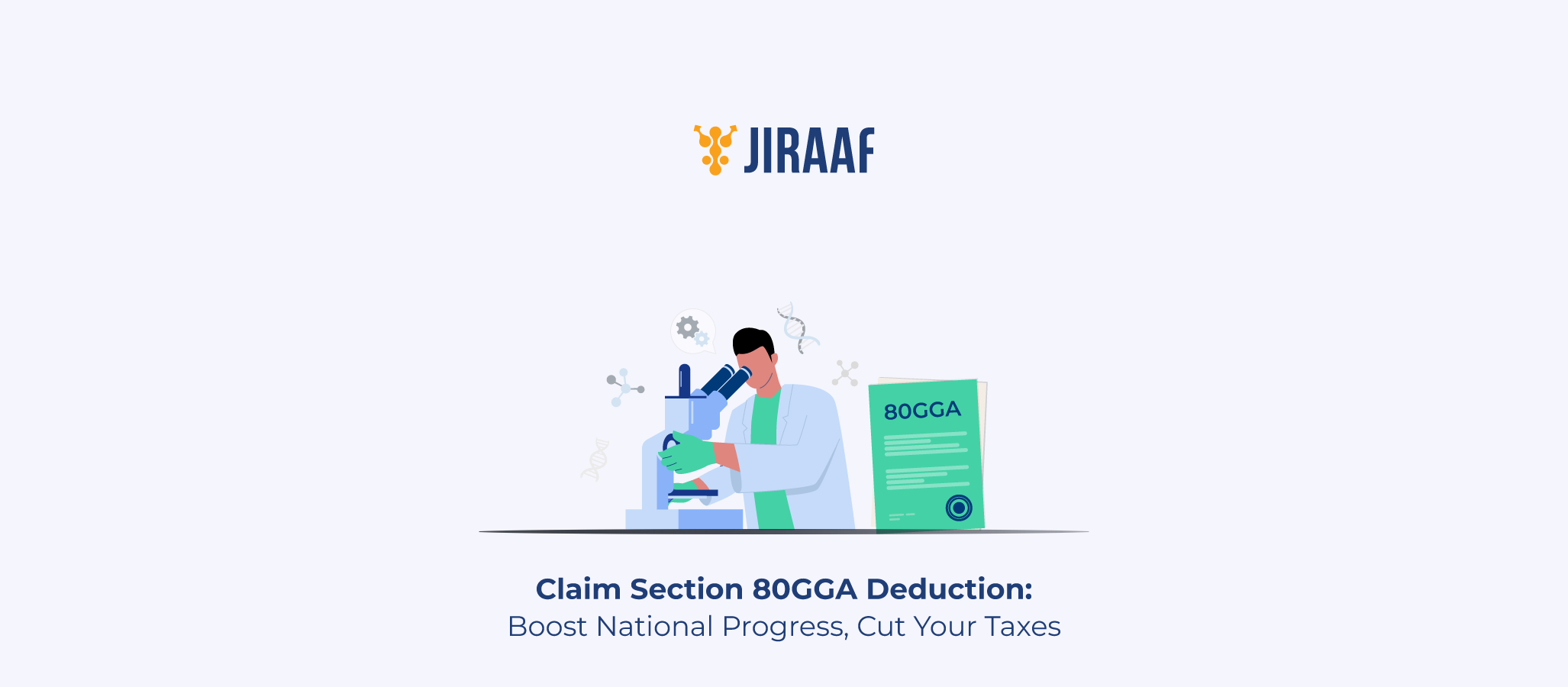
When you contribute to society through research or rural development, you’re not just making a difference—you’re also making a smart tax-saving move. Whether you’re funding scientific innovation or promoting sustainable development in rural areas, the government rewards your efforts. Section 80GGA of the Income Tax Act gives you a chance to support national causes and receive tax deductions in return.
In this blog, you’ll discover who qualifies for this deduction, what kinds of donations are eligible, and how you can claim your benefit while filing your Income Tax Return (ITR). So, if you’re looking to do good and save money on taxes while you’re at it—read on!
What is Section 80GGA of the Income Tax Act?
Section 80GGA offers tax deductions to individuals who donate towards certain causes like:
- Scientific research
- Rural development programs
- University or approved institutions
The government uses this section to encourage public participation in national initiatives where funding is critical. And the best part? If you don’t have income from business or profession, you can claim 100% of the eligible donation as a deduction—without any upper limit!
Who Can Claim Section 80GGA Deduction?
Section 80GGA is applicable to:
- Individuals
- Hindu Undivided Families (HUFs)
- Companies (not having income under the head “Profits and Gains of Business or Profession”)
- Firms and other taxpayers (non-business income only)
Important: If you have any income under “Business or Profession”, you cannot claim deductions under Section 80GGA.
Eligible Donations Under Section 80GGA
Here are the types of donations that qualify for 100% deduction under Section 80GGA.
1. Scientific Research
Donations made to:
- Approved scientific research associations
- Approved universities, colleges, or institutions involved in scientific research
2. Rural Development
Contributions to:
- Rural development funds approved by the central government
- National Poverty Eradication Fund
- Approved institutions for rural development projects
3. Conservation of Natural Resources
Donations to:
- Funds for afforestation
- Environmental sustainability projects
- Approved ecological bodies
4. Statutory Bodies
Any donation to:
- Indian Council of Agricultural Research (ICAR)
- Indian Council of Medical Research (ICMR)
- Other notified institutions
Mode of Payment: All donations above ₹2,000 must be made digitally (cheque, draft, UPI, bank transfer, etc.). Cash donations above this limit are not allowed for deduction.
Conditions to Keep in Mind While Claiming 80GGA
- No Business Income: The section is strictly for taxpayers who do not have income from business or profession.
- Digital Payment Mandate: Any donation above ₹2,000 must be made in non-cash mode.
- PAN of the Donee Institution: You must collect the PAN and approval certificate of the institution you donate to.
- Proof of Donation: Ensure you keep receipts and documentation ready for verification or audit.
How to Claim 80GGA Deduction While Filing ITR
Step-by-Step Process
- Choose the correct ITR form. ITR-1 or ITR-2 if you don’t have business income.
- Navigate to Section “80GGA” under Deductions. Under Chapter VI-A.
- Enter donee Details. Name, PAN, and approval number of the institution.
- Enter donation amount. As per the donation receipt.
- Upload supporting proofs (if applicable). Not mandatory but advisable.
Where to Show in ITR-1 or ITR-2?
- In ITR-1, go to “Deductions under Chapter VI-A” and choose “80GGA”.
- In ITR-2, navigate to “Schedule VI-A” for claiming this section.
Example
Let’s imagine that Priya is a salaried employee with an annual income of ₹8 lakhs. She donated ₹25,000 to an approved rural development NGO via net banking.
Since Priya does not have any business income, she can claim the full ₹25,000 as a deduction under Section 80GGA while filing her ITR.
This brings down her taxable income to ₹7.75 lakhs—resulting in lower tax liability.
Common Mistakes to Avoid
| Mistake | Why It’s a Problem |
| Donating in cash above ₹2,000 | Disqualifies your entire donation for deduction |
| Claiming deduction with business income | Not allowed under Section 80GGA |
| Missing PAN of the institution | May lead to disallowance of the claim |
| Using unapproved institutions | Donations must be to approved organizations |
| Forgetting to collect donation receipt | You’ll have no proof during scrutiny or audit |
Section 80GGA vs Section 80G: Key Differences
| Feature | Section 80GGA | Section 80G |
| Purpose | Research & rural development | General donations (e.g., PM CARES) |
| Eligible Taxpayers | No business income | Business & non-business both |
| Deduction | 100% (in most cases) | 50% or 100% (depending on donee) |
| Payment Mode | Non-cash for ₹2,000+ | Same rule |
| Documentation | PAN & approval of institution | PAN & approval required |
Contribute to Social Good While Saving Tax
Section 80GGA isn’t just about saving tax—it’s about contributing to something meaningful. Whether you’re helping fund life-saving research or supporting development in underprivileged regions, your money works in more ways than one.
By taking a few extra minutes to understand how to claim this deduction, you ensure that your charitable intentions are rewarded fairly by the tax system. Always remember to verify institutions, retain receipts, and file your ITR carefully.
With Section 80GGA, doing good also makes great financial sense.
FAQs
What is Section 80GGA of the Income Tax Act?
Section 80GGA allows a 100% tax deduction on donations made toward approved scientific research or rural development institutions, provided you don’t have business or professional income.
Who can claim deduction under Section 80GGA?
Any individual, HUF, company, or firm (excluding those with business income) can claim this deduction if they donate to eligible institutions or funds.
Can business owners claim Section 80GGA benefits?
No, if you have any income under the head “Profits and Gains of Business or Profession,” you’re not eligible to claim deductions under Section 80GGA.
Is cash donation allowed under Section 80GGA?
Only up to ₹2,000. Any donation above ₹2,000 must be made via non-cash modes like bank transfer, UPI, or cheque to qualify for deduction.
What documents are needed to claim 80GGA deduction?
You’ll need the donation receipt, PAN of the donee institution, and approval details of the organization to successfully claim the deduction in your ITR.
Discover fixed income investments with Jiraaf, a SEBI registered online bonds platform that educates and brings access to a wide array of bonds. Sign up today to explore diversified fixed income investment opportunities to support your goal-based wealth creation journey. Start investing!