Nobody talks about the moment money runs out.
Not at Women’s Day panels.
Not in the “girl boss” content that floods your feed every March.
We celebrate the salary negotiation won, the promotion earned, the business launched, and then the conversation quietly stops, right at the point where it matters most. But what happens after the money arrives determines everything. Whether that income becomes a safety net or simply a cycle you can never step off depends entirely on one thing: what you choose to do with it next.
Here’s the uncomfortable truth: earning is not the same as being free. A woman can have a six-figure salary and still be one health crisis, one job loss, or one difficult marriage away from financial ruin, if that income isn’t being strategically grown and protected. Real independence isn’t measured in what you earn per month. It’s measured in how many months you could sustain your life without earning at all.
That is the conversation we need to have this International Women’s Day 2026. Not just about breaking glass ceilings, but about what you build once you’re on the other side of them.
Why Women Need a Different Financial Playbook
Financial independence isn’t a universal formula you can copy from a generic investment guide. For women, the economic landscape comes with variables that demand a far more intentional approach to wealth-building, variables that most standard financial advice ignores.
Women in India live, on average, nearly three years longer than men. That gap sounds small in conversation, but in retirement planning terms, it represents three additional years of expenses, healthcare costs, and inflation exposure; years that most calculators don’t account for. A retirement corpus designed around a male-average lifespan is, for women, structurally deficient.
Then there is what economists call the “caregiving gap”. Millions of women in India step away from active employment at some point, to raise children, to care for aging parents, or carry a household through crisis. These aren’t failures of ambition. They are expressions of love and responsibility. But they carry real financial consequences: interrupted SIP contributions, paused salary increments, gaps in provident fund accumulation. During these periods of zero active income, a reliable secondary income stream shifts from being a nice-to-have to an absolute necessity.
Finally, there is inflation, the silent thief that never announces itself. With healthcare inflation in India hovering between 12 and 14%, money sitting in a traditional bank account isn’t being kept safe. It is being slowly consumed. The balance grows, the interest trickles in, and yet your actual purchasing power shrinks year after year. True financial protection isn’t about preserving rupees. It’s about preserving what those rupees can buy.
This is precisely why investing is non-negotiable for women. It is the only bridge between today’s labor and tomorrow’s liberty.
The Hidden Cost of Playing It “Safe”
For generations, women have been quietly steered toward saving over investing. Fixed deposits. Recurring accounts. “Keep it safe, keep it simple”. The instinct to hold money carefully is not wrong, but when saving becomes the entire strategy, it works against you in ways that aren’t immediately visible.
A savings account offering 3–4% annual interest in an inflationary environment doesn’t protect your wealth. It erodes it with time. The numbers look stable. The balance inches upward. And yet your real purchasing power shrinks. This is the paradox of the “safe” choice: the illusion of security masking a slow, invisible loss.
The question, then, is not whether to engage with financial risk. It is about understanding which risks are worth taking, and which tools exist to manage them wisely, on your terms.
The Case for Debt Investments: Growth Without the Turbulence
Not every woman wants to track stock prices between meetings. Not everyone has the appetite for the emotional rollercoaster of equity markets: the sudden dips, the news-driven panic, the uncertainty of not knowing whether tomorrow will erase what took years to build. That is a completely rational position to hold.
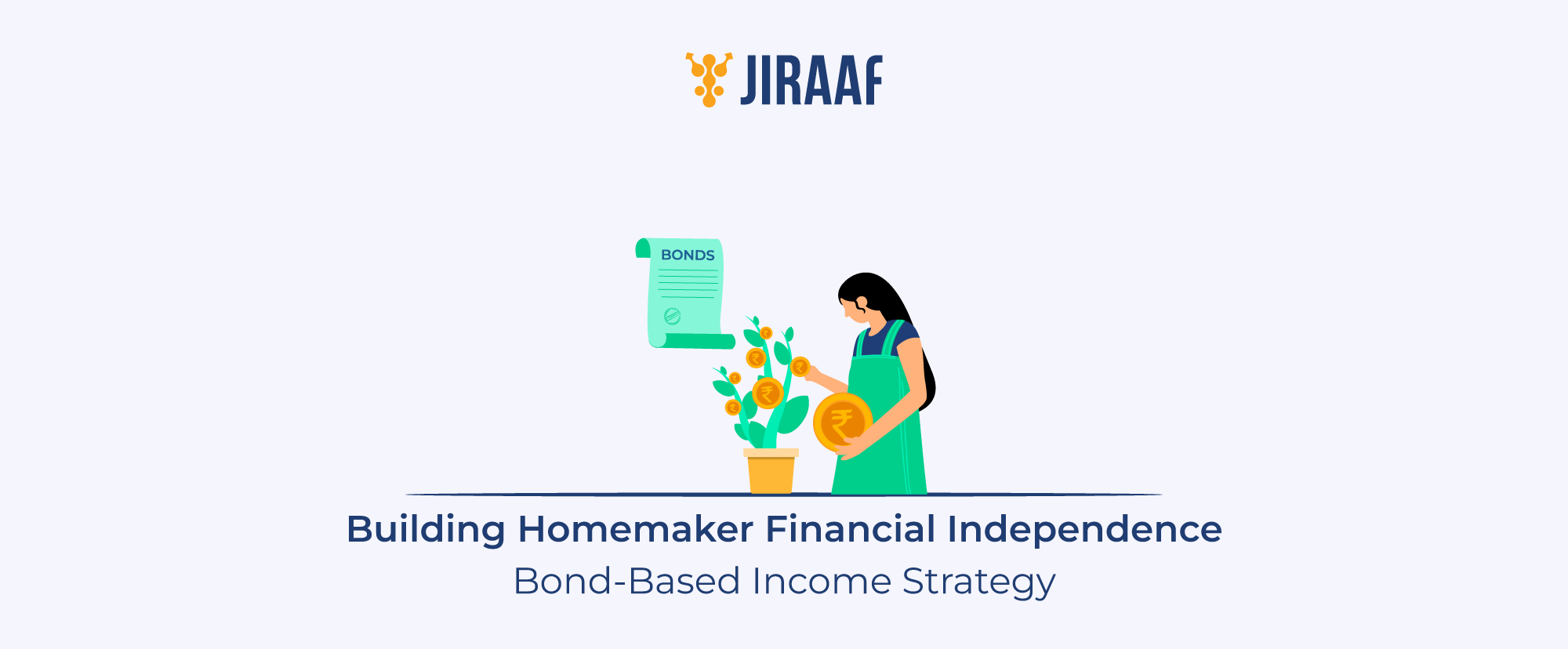
This is where corporate bonds enter the picture and make a compelling case for themselves. When you invest in a corporate bond, you become the lender. An established company borrows capital from you and, in return, commits to paying you a fixed interest rate over a defined tenure. There is no ambiguity. You know what you can earn, and you know when. It is a contract, not a speculation.
The structural advantages are meaningful. Predictable cash flow means regular interest payouts, monthly or quarterly, that can either fund your current expenses or be reinvested to accelerate compounding. Lower volatility means that when global markets spiral on the back of geopolitical news or economic data, your bond interest continues arriving on schedule, undisturbed. And today, platforms like Jiraaf have removed the access barrier that once kept this asset class exclusively in institutional hands; individual investors can now access curated, credit-analyzed corporate bonds with annual returns currently ranging from 8 to 14%, depending on the issuer’s risk profile.
For women who want their money to grow steadily, without requiring daily attention or emotional endurance, debt instruments offer exactly the kind of strategic stability that makes long-term independence achievable.
Retirement, Reimagined: Building Your Own Private Pension
Retirement for women is about beginning a chapter of complete autonomy; one where every decision you make is powered by choice rather than necessity. Building toward that chapter requires a different kind of financial thinking.
As retirement approaches, the investment goal shifts from aggressive accumulation to intelligent preservation. The capital you have spent decades building must now be protected, while continuing to generate enough income to sustain your lifestyle through a potentially 25-to-30-year horizon.
Corporate bonds are particularly well-suited to this phase. One powerful approach is constructing a ladder by investing in bonds with staggered maturity dates so that a portion of your corpus becomes liquid at regular, predictable intervals. Rather than managing a single large lump sum, you create a self-generated income stream that functions like a private pension: steady, structured, and entirely yours.
Bonds also serve as the stabilizing ballast within a diversified portfolio. When equity markets decline, you are not forced to sell stocks at a loss simply to cover monthly expenses, because your bond income is already handling that. This distinction separates portfolios that survive market downturns from those that are permanently damaged by them.
Four Small Steps You Could Start This Month
You don’t need a finance degree or a large starting corpus. You need a clear framework and the decision to begin.
Step 1: Define your whys
You can identify your goals across three horizons: short-term (a home down payment, an emergency buffer), mid-term (education funding, a business you want to launch), and long-term (a retirement that depends on no one but you). Purpose drives every investment decision that follows.
Step 2: Build your buffer first
Before committing money to any fixed-term instrument, it is smart to ensure that you have six to nine months of living expenses in a liquid fund. This is your financial immune system; the thing that ensures an unexpected expense doesn’t force you to break your investments prematurely.
Step 3: Allocate deliberately for stability
You can dedicate a defined portion of your portfolio to debt instruments like corporate bonds. This creates regular income, offsets the risk of equity holdings, and ensures your wealth-building isn’t entirely hostage to market cycles.
Step 4: Use verified, transparent platforms
Technology has made investing more accessible than ever, but not all platforms are equal. Smart investors prioritize those that provide rigorous credit analysis, clear risk ratings, and transparent documentation, so your decisions are informed by data rather than driven by faith.
The Most Radical Thing You Can Do This Women’s Day
Forget the flowers. Forget the carefully worded corporate posts about “empowering women” from companies that still have gender pay gaps. If you want to do something genuinely meaningful this Women’s Day, open a spreadsheet. Look at where your money is sitting. Ask, plainly and without judgment, whether it is actually working for you, or simply waiting.
Financial security is built through decisions: the decision to move beyond the false comfort of a low-interest savings account, the decision to learn what debt investments actually mean, and the decision to treat your future self with the seriousness and care it deserves.
Corporate bonds, income ladders, diversified portfolios, these are not the exclusive vocabulary of the wealthy. They are the tools of women who have decided, quietly and without fanfare, that they will not leave their financial futures to chance, to markets, or to anyone else.
The most enduring form of independence a woman can build isn’t a title on a business card. It isn’t a salary that impresses at dinner parties. It is the unshakeable knowledge that her life is funded by the choices she made, the assets she owns, and the strategy she controls. That is what freedom actually feels like, and it is entirely within reach.