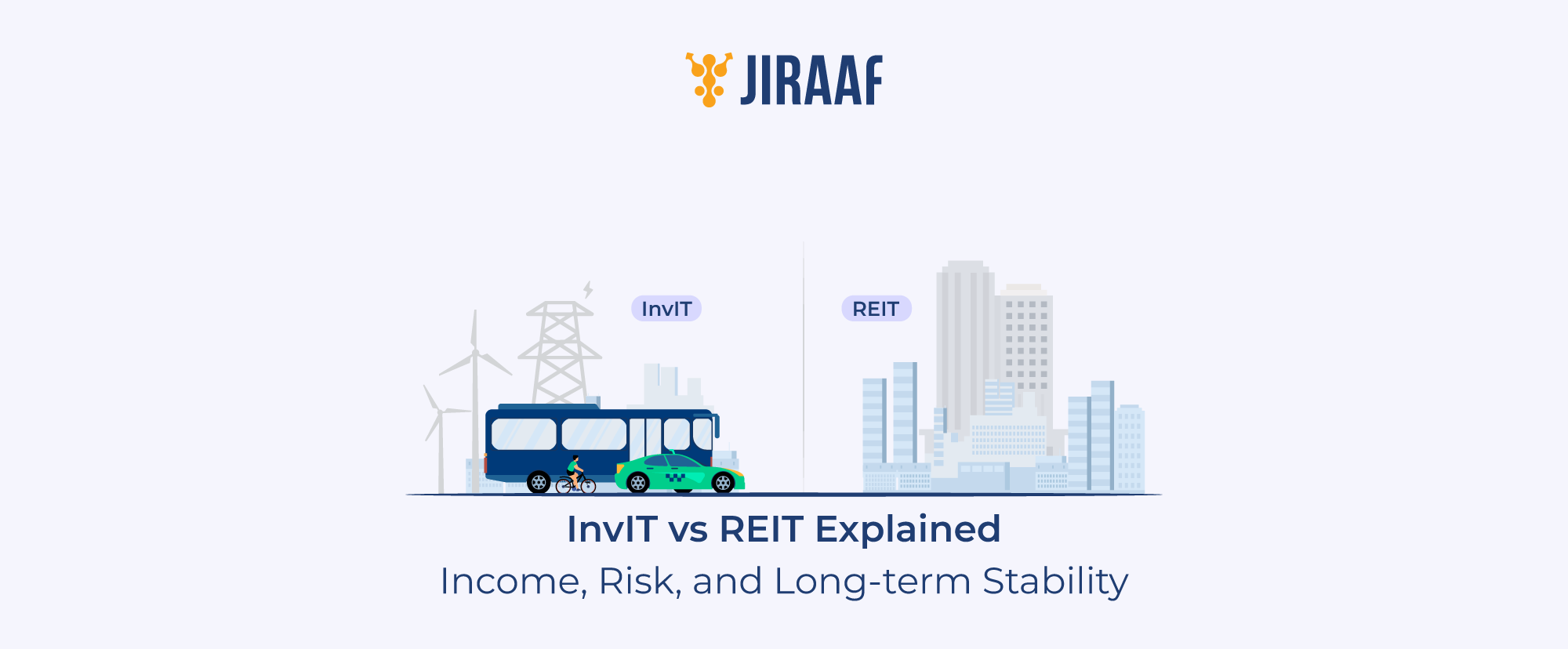
Confused between REITs and InvITs? This blog explains what they are, how they differ, and which is better for stable, long-term returns, in a clear, easy-to-understand format.
REITs and InvITs have unlocked access to asset classes that once demanded substantial capital and institutional-scale participation. They now enable individual investors like you to channel your money into India’s growth story by funding the commercial real estate and infrastructure that power the country’s expansion.
And as a result, both of these vehicles have surged in popularity, with REITs recently crossing the ₹ 1 trillion mark in market capitalization and InvITs touching ₹6.3 lakh crores. Their AUM is expected to multiply significantly over the next 5–7 years, reflecting growing investor confidence.
In today’s blog, we unpack what REITs and InvITs are, how they differ, and which option offers more stable returns for investors.
What are REITs?
Real Estate Investment Trusts or REITs allow everyday investors like you to become partial owners of high-value commercial properties by purchasing Net Asset Value (NAV) units (similar to mutual funds) for as low as ₹10,000 to ₹15,000. REITs operate as companies that own, manage, and operate income-generating real estate assets.
How REITs Work
REITs operate on a simple yet highly structured model that deploys your capital and channels it into revenue-generating real estate. Here’s how the process unfolds:
- A sponsor (usually a real estate developer) creates a REIT and transfers some of its completed, income-producing properties into the trust.
- The REIT is then listed on the stock exchange, allowing regular investors to buy units, similar to buying shares of a company.
- The capital raised from these units is used to manage or expand the portfolio of commercial properties.
- The underlying assets such as offices, malls, warehouses, hotels, or business parks, start generating steady rental income.
- This rental income is distributed back to you, creating a predictable stream of returns.
Eligibility Criteria for a REIT
For a company to be recognized and regulated as a REIT in India, it must satisfy a strict set of criteria laid down by SEBI.
1. Structure and asset composition
- Must be a trust registered under the Indian Trusts Act, 1882 and SEBI’s REIT Regulations
- Must have an asset base of at least ₹500 crore
- 90% of total investments must be in quality assets
- 10% can be allocated to developing assets
- Investments must be focused on commercial real estate such as offices, malls, hotels, and business parks
2. Investor and ownership rules
- Must have at least 200 unitholders
- No single investor can hold more than 25% of the REIT units other than the sponsor/manager or their associates. However, a single person can hold more if they are a Qualified Institutional Buyer or QIB.
- Stock-exchange listing is mandatory, ensuring liquidity and market-driven pricing
3. Income distribution and reporting
- REITs must distribute at least 90% of their net income to investors, typically every quarter (or semi-annually), to ensure consistent cash flow
- NAV must be declared twice every financial year
- The remaining income can be reinvested in asset upgrades or new acquisitions
If REITs open the door to owning a piece of India’s commercial real estate, InvITs take the story a step further by giving you access to the country’s infrastructure engine. Let’s look at how InvITs help you participate in India’s infrastructure development.
What are InvITs?
Similar to REITs, Infrastructure Investment Trusts, or InvITs, also pool money from multiple investors. However, InvITs invest the raised capital across infrastructure projects like railways, roads, highways, power plants, transmission lines, pipelines, and telecom towers.
How InvITs Work
InvITs follow a carefully regulated, multi-layered structure designed to ensure stable long-term income for you. Here’s how the entire system functions:
- Sponsor
An infrastructure developer can create an InvIT. The sponsor must have a minimum net worth of ₹10 crore (or ₹100 crore in the case of a company/LLP that sets it up) and at least five years of sector experience. Additionally, the sponsor must contribute at least 15% of total units, locked in for three years, ensuring skin in the game.
- Setting up the trust
After InvIT creation, the sponsor pools a portfolio of completed, income-generating infrastructure assets into a trust structured under the Indian Trusts Act, 1882. Sometimes, these assets are held directly by the trust; other times, they are housed in Special Purpose Vehicles (SPVs), in which the InvIT must maintain at least a 51% stake.
- Trustee
A SEBI-registered, independent trustee is appointed to safeguard investor interests and ensure full regulatory compliance. Once appointed, the trustee assumes control over the InvIT’s assets; the sponsor can no longer operate them.
- Managers
Two specialized managers are appointed:
- An investment manager who makes investment decisions and manages operations
- A project manager who oversees execution, maintenance, and day-to-day management
- Raising funds
After registration, an InvIT may choose to list its units on the stock exchange or raise capital privately. In the secondary market, retail and institutional investors can buy units with a reduced minimum investment of ₹10,000 to ₹15,000, tradable in lots of one unit. However, for a public issue, the minimum application size remains significantly higher at ₹10,00,000.
- Revenue generation
InvITs primary earn money through tolls, transmission charges, user fees, annuity payments, or long-term concession agreements with government or private bodies. These revenues are pooled and used to cover maintenance costs, debt repayment, and operational expenses.
- Distribution to investors
Similar to REITs, at least 90% of net distributable cash flow generated from the infrastructure assets must be paid to unitholders, giving investors a steady, bond-like income stream without owning or operating the assets themselves
Eligibility Criteria for InvITs
InvITs operate under a stringent regulatory framework set by SEBI to ensure transparency, disciplined asset selection, and predictable income distribution. Key requirements include:
1. Investment composition
- Minimum 80% of assets must be invested in completed, revenue-generating infrastructure projects
- The remaining 20% may go into under-construction assets, listed/unlisted debt of infrastructure companies, equity of companies with at least 80% infra-based revenue, money-market instruments, or government securities
2. Structure and Governance
- Must be set up as a trust and registered under SEBI InvIT Regulations
- Trustee must be independent and have no association with the sponsor
- Must also appoint:
- A SEBI-approved trustee
- An investment manager
- A project manager
3. Listing and transparency
- InvITs can be publicly listed or privately placed
- NAV must be updated twice a year as per SEBI mandates
- Regular reporting ensures transparency in operations, debt levels, cash flows, and asset performance
- Minimum public unitholding of 25% must be achieved within three years of listing (for listed InvITs)
With both real estate and infrastructure now clearly mapped out, it’s time to place them side by side and see how the two differ.
What are the Key Differences Between REITs and InvITs
| Parameter | REITs | InVITs |
| Underlying Assets | Commercial real estate properties (office spaces, malls, warehouses, hospitality centers, healthcare facilities) | Infrastructure assets (highways, roads, power transmission lines, pipelines, telecom towers, data centers, renewable energy) |
| Primary Income Source | Rental income from tenants and property leases | Toll collections, usage fees, service charges, tariffs from concessions, and annuity payments |
| Return Profile & Yield | Moderate growth with higher dividend yields typically 6-8% annually | Stable returns with predictable yields typically 8-10% annually from long-term contracts |
| Risk Profile | Linked to occupancy rates, tenant quality, rental rates, property valuations, and real estate market trends | Linked to project-specific risks, regulatory changes, policy risks, toll traffic volumes, and tariff restrictions |
| Liquidity | High liquidity; units listed on NSE and BSE with active trading | Lower liquidity; InvITs are less liquid than REITs because they are often associated with long-term projects |
| Tax Treatment on Dividends and Interest | Both interest and dividend are taxed at applicable slab rates with 10% TDS (for residents) | Both interest and dividend are taxed at applicable slab rates with 10% TDS (for residents) |
How do REITs and InvITs Generate Returns for Investors?
While REITs and InvITs share many similarities, the way they generate returns differs. Here’s how.
REITs
REITs generate returns mainly through rental income from commercial properties and property value appreciation. They lease out offices, malls, and warehouses under long-term contracts, creating predictable cash flows. As per regulations, REITs distribute at least 90% of their net distributable cash flow, usually quarterly or semi-annually, making dividends the primary source of investor earnings. When real estate values rise, REIT unit prices often appreciate as well, adding a growth component to returns.
InvITs
InvITs earn through infrastructure revenues such as tolls, tariffs, user fees, and annuity payments from assets like highways and transmission lines. They also receive dividends and interest from SPVs that hold these projects. InvIT returns are primarily driven by long-term government contracts and concession agreements.
Which Is Better for Stable Returns; REIT or InvIT?
Both REITs and InvITs offer a smart way to earn stable, passive income without owning physical assets. The better option ultimately depends on your investment goals, risk appetite, and comfort with market or project-linked risks.
For instance, if you prefer stable income potentially linked to economic growth and property cycles, REITs may appeal more. On the other hand, if you seek higher yields and long-term contractual cash flows with potentially lower volatility due to government/authority-backing, InvITs could be a stronger fit. Evaluating your return expectations, risk tolerance, and investment horizon will help you pick the trust structure best suited for your long-term income strategy.