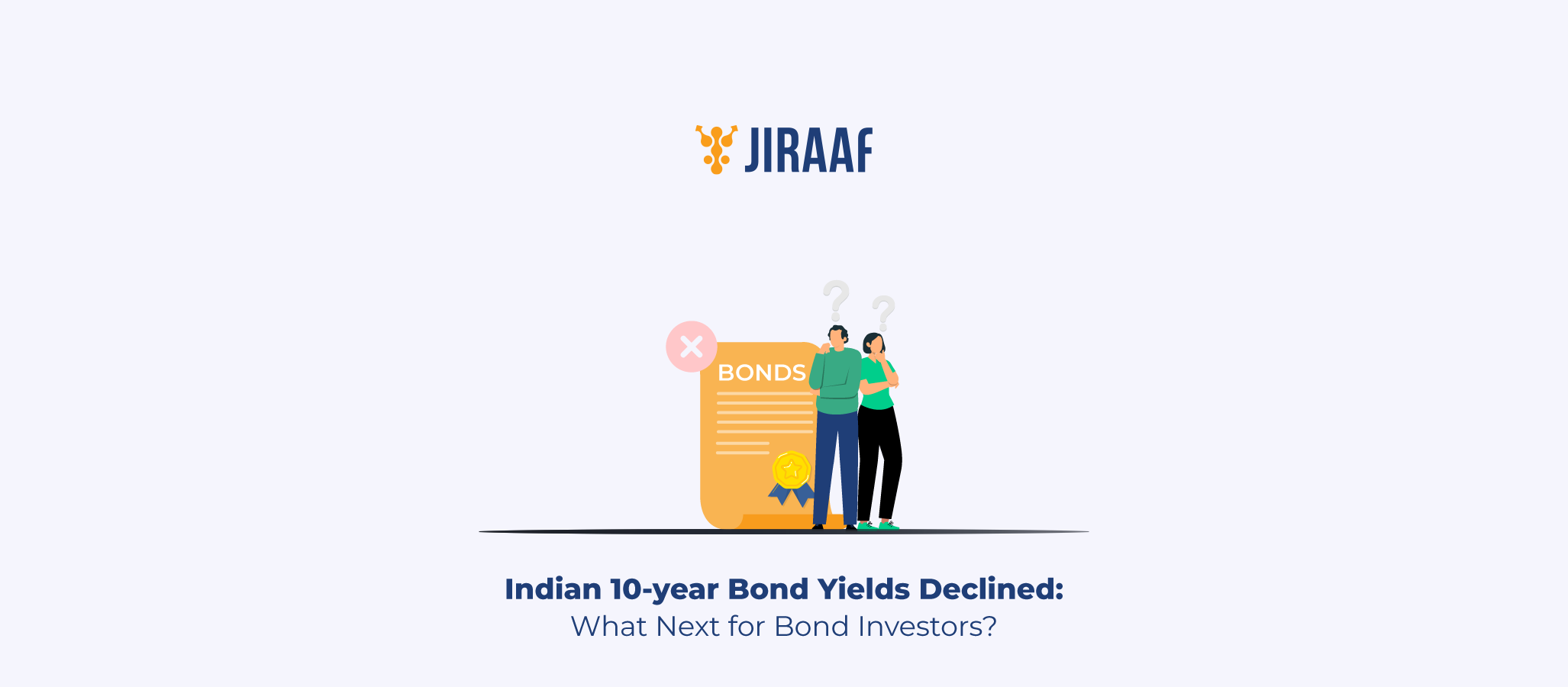
Something unusual happened before the April’25 RBI meeting—India’s 10-year government bond yields dipped to a three-year low. For investors watching the bond market, this was more than just a blip—it could signal changing winds in the economy.
The benchmark 10-year G-sec yield dropped below 6.5% for the first time in 3-years, catching the attention of bond traders, mutual fund managers, and retail investors alike. This sharp decline came on the back of moderating inflation, a change of stance by the RBI, and global cues pointing to rate cuts. But what does it all mean for bond investors—and more importantly, how should you respond?
So, what triggered this rally in bond prices? Was it just a pre-policy positioning move, or does it indicate something deeper—a shift in investor expectations, inflation trajectory, or even RBI’s future stance?
This blog unpacks the story behind the sharp dip in long-term yields, explores how it impacts you as an investor, and makes the case for why retail investors should keep an eye on corporate bonds—especially with online bond platforms making access so much easier today.
Understanding the 10-Year Bond Yield Drop — what’s Really Happening?
The sharp dip in early April 2025 wasn’t just a fluke. When the 10-year bond yield fell from around 6.6% to 6.4%—it reflected something more than a technical market move. For seasoned bond watchers, it confirmed that markets are pricing in a changing interest rate regime.
So what’s really going on under the hood? Why did yields fall so fast, and what does it mean for you as an investor? Let’s break it down.
Here are the likely triggers behind the sharp fall:
Policy Shift Already Underway: RBI Turns Dovish
In a significant move, the Reserve Bank of India cut the repo rate by 25 basis points (bps) in February 2025, having already shifted its stance from “withdrawal of accommodation” to “neutral” in December 2024. We saw an additional 25 bps rate cut the the April’25 RBI meeting and a further shift of stance from ‘neutral’ to ‘accommodative’.
The central bank cited moderating retail inflation—now below 5%—and easing core inflation as key drivers for its policy pivot, while also revising the FY 26 inflation forecast to 4% from 4.2%.
This dovish shift triggered renewed demand for bonds, especially long-duration securities, as investors began to price in the possibility of further rate cuts later in the year. As a result, bond yields softened across the curve, and the 10-year G-sec yield dipped below the 6.5% mark, reflecting improved sentiment and a broader market recalibration to a lower interest rate regime.
Global Cues Already Favourable for Bond Markets
The global backdrop has also supported the rally in Indian bonds. The US Federal Reserve began cutting interest rates in late 2024 after signs of a cooling job market and easing inflation, clearly pivoting from its earlier tightening cycle. These cuts led to a decline in US Treasury yields, which in turn triggered a ripple effect across global debt markets. Indian bond yields, which often respond to global trends—especially during periods of increased foreign portfolio investor (FPI) activity—also came under downward pressure. With global capital chasing better real returns, the environment became more supportive for Indian fixed-income assets, reinforcing the rally in domestic bond markets.
Strong Demand from Institutional Buyers
Demand from institutional investors added further momentum to the yield decline. Large domestic institutions such as insurance companies, pension funds, and mutual funds began increasing their exposure to long-duration bonds, anticipating capital gains from falling yields. Banks, too—flush with liquidity post fiscal year-end—turned into aggressive buyers of sovereign bonds. This surge in institutional appetite created consistent buying pressure, especially in the 10-year segment, further lowering yields across the curve.
Fiscal Deficit and Borrowing Outlook
Fiscal signals were equally reassuring. In the Union Budget 2025-2026, the government announced a gross market borrowing target of ₹14.82 lakh crore for FY2025-26, slightly higher than earlier projections. This came as a relief to the bond market, as any significant increase could have triggered fears of oversupply. More importantly, the government lowered its fiscal deficit target to 4.4% of GDP for FY2025-26, down from 4.8% in the previous year. This indicated a clear commitment to fiscal consolidation and helped ease concerns about long-term debt sustainability, further supporting the case for stable or lower yields.
Why Falling Bond Yields Matter and Who Stands to Gain
To the casual observer, a dip in bond yields may seem like a technical blip. But for investors—especially those in fixed income—it’s a signal worth decoding.
What Does a Falling Yield Really Indicate?
When the benchmark 10-year G-sec yield drops, it reflects more than just demand for bonds. It’s a sign that the broader economy and interest rate environment are shifting.
| Interpretation | What It Signals |
| Bond prices are rising | Investors expect falling rates or are locking in current yields |
| RBI may cut or pause rates | A more accommodative policy stance is likely |
| Inflation is moderating | Lower inflation expectations across the board |
| Growth appears stable | No urgent need for tight monetary policy |
| Lower rate volatility expected | Long-term bonds become more attractive |
In short, falling yields usually create a favourable environment for existing bondholders, and a window of opportunity for new investors—though that window can close quickly as yields compress further.
Why the 10-Year Benchmark Matters
The 10-year G-sec is not just another bond—it’s the heartbeat of India’s debt market.
- It acts as the risk-free rate benchmark, influencing pricing for corporate bonds and other debt instruments.
- It helps determine loan and deposit rates across the banking system.
- It’s the most liquid and closely tracked bond in India—used by fund managers, institutional investors, and global players to read market sentiment.
So when this benchmark moves, it reverberates across the entire yield curve, affecting portfolios, borrowing costs, and risk premiums.
Who Benefits When Yields Drop?
Here’s how different investor groups can benefit from falling yields:
Retail Bond Investors & Target Maturity Fund Holders
- Existing bondholders see capital gains as prices rise.
- Long-duration bonds and laddered G-Sec strategies likely show mark-to-market gains.
Corporate Bond Investors
- As G-sec yields fall, corporate bonds become more attractive by comparison.
- Platforms showcasing high-quality AAA and AA-rated bonds offer an edge in returns.
SIP Investors in Debt Mutual Funds
- Gilt funds, constant maturity funds, and dynamic bond funds gain value.
- Falling yields enhance long-term return potential and help diversify portfolios alongside equities.
Is This the Start of a New Bond Rally?
It may be too soon to call it a full-fledged bull run, but signs of a sustained bond market rally are starting to build. Yields across tenures are softening, and sentiment is turning decisively positive.
Key Indicators to Watch:
| Factor | Current Signal | Implication |
| CPI Inflation | Trending downward | Positive for bonds, more policy flexibility |
| RBI Stance | Neutral, with dovish tilt | Room for further easing |
| Fiscal Deficit | Well-managed | Reduced pressure on bond supply |
| Global Yields | Softening slightly | Favourable for emerging market debt |
This setup points toward a more stable bond yield environment—ideal for investors seeking predictable returns and lower volatility, especially those approaching retirement or prioritising capital preservation.
With inflation appearing under control and global cues supporting risk-on sentiment, many analysts expect the 10-year G-sec yield to trend toward 6.5% by mid-2025. However, the outlook still depends on external shocks—cooling oil prices, food inflation, or fresh geopolitical risks could stall the rally.
In short: the bond market isn’t in euphoric territory yet, but the odds are increasingly tilting in favour of lower rates and rising bond prices over the next few quarters.
What Lies Ahead for Bond Investors
The writing on the wall is clearer now — a rate cut is no longer a question of ‘if’ but ‘when’.
With inflation largely within the RBI’s comfort zone and the Fed expected to cut rates later this year, the momentum toward a globally synchronized rate-easing cycle is building.
How Low Can Bond Yields Go?
Historically, India’s 10-year G-Sec yield tends to drop significantly in a rate-cut cycle. Here’s how yields behaved during past easing phases:
| Rate Cut Phase | Repo Rate Change | 10-Year G-Sec Movement |
| 2008–2009 (Global crisis) | 9% → 4.75% | ~9% → 6.2% |
| 2015–2017 | 8% → 6% | ~8.2% → 6.5% |
| 2019–2020 (Pre-COVID + pandemic) | 6.5% → 4% | ~7.5% → 5.8% |
If the RBI begins cutting in 2025, the 10-year yield could reasonably trend toward 6.5–6.4%, and maybe lower depending on global cues.
Strategic Moves Based on Your Risk Appetite
Here’s how investors can approach the current market, depending on their investment profile:
| Investor Type | Recommended Strategy |
| Conservative (low risk) | Lock into high-quality AAA bonds or G-Secs now; hold to maturity |
| Moderate | Consider TMBFs (target maturity bond funds) or laddered bond portfolios |
| Aggressive | Tactical play via long-duration bonds or Gilt Funds for capital gains |
| Income-seekers | Choose high-coupon PSU/NBFC bonds with quarterly or annual interest |
Bonus Insight: Some bond platforms allow you to filter for interest payment frequency — monthly, quarterly, or annual — so you can plan cash flows better.
Sectors to Watch: Where Yields Still Look Attractive
While AAA-rated PSU and bank bonds have seen yields drop slightly, there are still pockets offering better risk-reward:
- High-rated NBFCs (AA+/AAA): Offering 7.60–8.10% yields
- Secured NCDs from infra lenders: Up to 8.50%
- New issues from housing finance companies (HFCs): May offer decent spreads over G-Secs
Keep an eye out for new listings or secondary trades on online platforms.
What Should Bond Investors Do Now?
So the RBI has turned dovish, bond yields have dipped, and long-duration papers have rallied. If you’re a retail investor watching all this unfold — here’s the big question:
Should you buy now, wait it out, or rebalance?
The short answer: It depends on what kind of bonds you hold (or want to hold), your investment horizon, and your return expectations.
Let’s walk through the scenarios.
Scenario 1: You Already Hold Bonds (G-Secs or Corporate Bonds)
You’re likely sitting on some unrealized gains thanks to the bond rally. Now you have two options:
| If You’re Holding | What You Can Do |
| Long-duration G-Secs or AAA bonds | Hold for more gains if yields drop further |
| Medium-term corporate bonds (3–5 years) | Continue holding for steady accrual returns |
| Target maturity bond funds (TMBFs) | Stay invested — rising NAVs and predictable maturity values |
Don’t rush to exit. If you’ve locked into good coupons and still have time to maturity, enjoy the ride.
Scenario 2: You Want to Invest Now — Is It Too Late?
Not at all. While yields have come down a bit, they’re still quite attractive, especially for:
- AAA-rated corporate bonds offering 7.40% to 7.75%, depending on tenure and issuer. For instance, recent issues by Axis Finance and Tata Capital have hovered near the upper end of this range.
- Taxable PSU and NBFC bonds in the 7.50% to 8.00% range. LIC Housing Finance, for example, reissued bonds maturing in 2028 at a yield of 7.68%.
- Online bond platforms continue to showcase curated, high-quality listings for retail investors—making it easier than ever to compare yields, ratings, and maturities before investing.
What to look for:
- Focus on high-credit quality
- Choose laddered maturities to spread risk
- Consider shorter or staggered tenure bonds if rates are volatile
Laddering Strategy: A Smart Play in a Falling Yield Cycle
A laddered bond portfolio—comprising bonds with staggered maturities (e.g., 1, 3, 5, and 10 years)—lets you reinvest gradually at future interest rates. It reduces reinvestment risk and improves cash flow visibility, especially useful in volatile rate environments.
This way, you avoid locking into one interest rate and ensure regular liquidity.
What about Tax-Efficient Options?
Don’t forget to factor in post-tax returns. With debt mutual funds losing indexation benefit, individual bonds, especially if held to maturity, can be tax-efficient.
| Instrument | Tax Treatment |
| Listed corporate bonds | STCG (≤12 months): Taxed at slab rate. LTCG (>12 months, sold on or after July 23, 2024): Taxed at flat 12.5% without indexation |
| Sovereign Gold Bonds | Capital gains exempt if redeemed at maturity (8 years) or via RBI’s early redemption window (after 5 years). Interest is taxable. |
| G-Secs bought via RBI Retail or platforms | Interest taxed as per slab; no TDS |
If you want steady, low-volatility income, buy-and-hold investing in bonds may now be more attractive than ever.
Leverage Online Platforms for Simpler Bond Access
For retail investors, online bond platforms have revolutionized how you can access corporate and sovereign debt.
- Search and filter bonds by yield, credit rating, maturity
- Easy KYC and seamless digital transactions
- Better transparency than secondary bond markets
- Access to pre-listed PSUs, AAA-rated NBFCs, and more
Some platforms also offer tools to compare across bonds, calculate yield-to-maturity (YTM), and even estimate interest payouts across timelines.
Final Thoughts: Time to Rebalance, Not Exit
Falling bond yields don’t mean you need to exit your fixed-income positions altogether. Instead, they’re a reminder that it’s time to rebalance your portfolio based on the evolving interest rate cycle. Locking into longer-term, high-quality bonds before yields fall further can help preserve returns in a declining rate environment.
With the RBI turning more accommodative and inflation largely under control, we could be in the early stages of a bond market upswing. Investors would do well to stay ahead of the curve—not by chasing past returns, but by aligning their strategies with what’s coming.
Now may be the ideal moment to explore instruments that offer stable returns with manageable risk. Corporate bonds—especially those available via trusted online bond platforms—allow retail investors to access curated opportunities that match their goals and time horizons. A little rebalancing now could mean a lot more resilience later.
For investors willing to act before the crowd catches on, the current bond environment may turn out to be one of the best entry points in years.