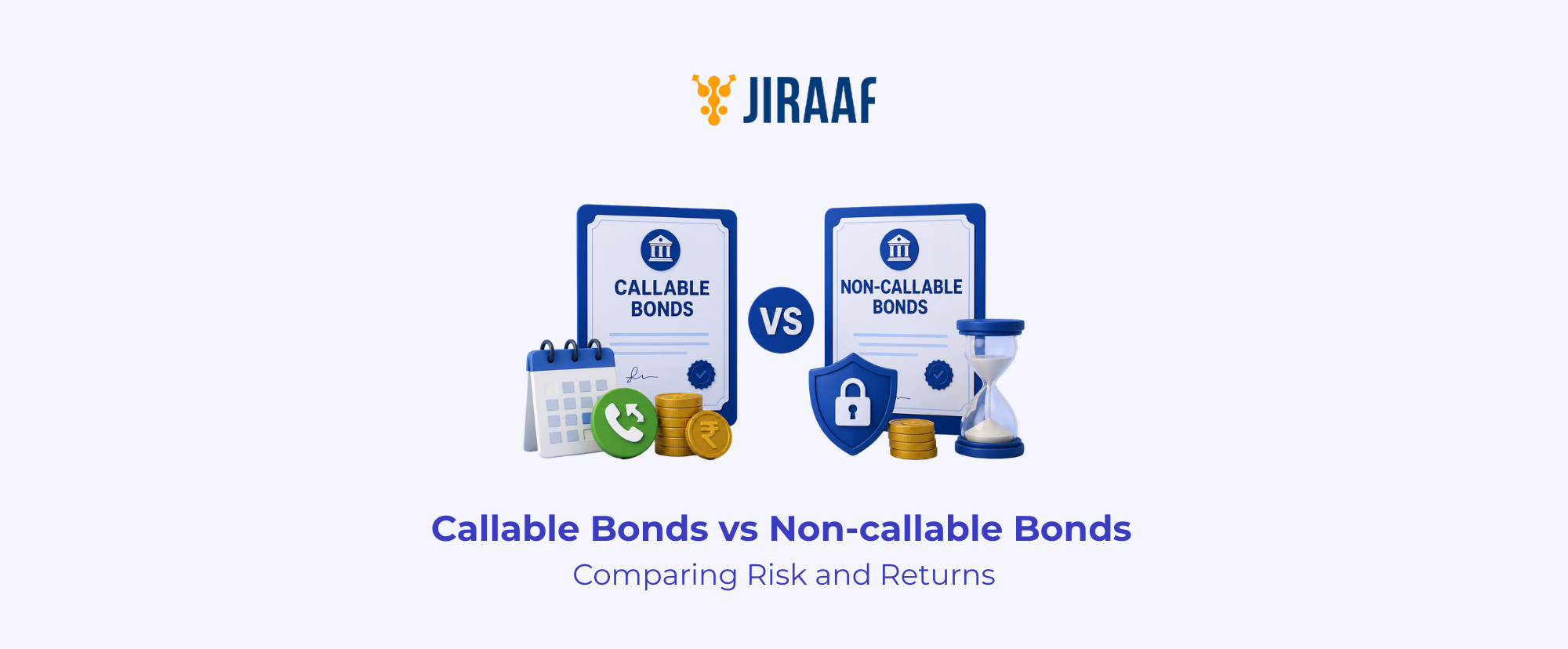
Summary: Callable bonds often attract investors with higher coupon rates, but the real trade-off lies in reinvestment risk and income uncertainty. This guide compares callable and non-callable bonds and explains how bond structure can influence long-term returns, cash-flow stability, and portfolio strategy.
Quick Overview
- Callable bonds offer higher coupons because issuers retain the right to redeem them early
- Non-callable bonds provide more predictable long-term income and cash-flow visibility
- In falling-rate environments, issuers are more likely to refinance callable bonds at lower borrowing costs
- Yield to Call (YTC) may matter more than Yield to Maturity (YTM) in callable structures
- In case your reliance is on regular income, non-callable bonds generally offer a more stable cash-flow structure
- In stable or rising-rate environments, callable bonds may provide you with higher current yields in exchange for early redemption
Two bonds can have similar credit quality and offer similar yields, yet the way they are redeemed by the issuer can have a very different impact on your returns. The difference between callable and non-callable bonds often comes from a feature hidden within the bond structure itself: whether the issuer can redeem the bond early.
An issuer can repay the investor before maturity with a callable bond, but non-callable bonds don’t give that flexibility. That distinction can affect cash flow expectations, reinvestment risk, and overall return expectations across different interest rate cycles.
Before deciding which structure works better, it helps to understand how callable and non-callable bonds actually behave in different market conditions.
What are Callable and Non-callable Bonds?
Callable Bonds
A callable bond allows its issuer to redeem the bond prior to its maturity. This means that if certain conditions are met, the issuer can choose to return your principal and end the investment earlier than originally planned. Companies issue callable bonds when they want to have the option to refinance if rates drop, to pay off existing debt, and reissue at a lower rate. Most callable bonds include a call protection period during which early redemption isn’t permitted. Once that period ends, the issuer can call the bond on the terms set at issuance. Generally, callable bonds offer investors like you a higher coupon rate to compensate for the risk that the issuer may redeem the bond early.
Non-callable Bonds
A non-callable bond sets its terms at issuance and keeps them fixed until maturity. Coupon payments run to maturity, making cash-flow planning more straightforward.
What is the Difference Between Callable and Non-callable Bonds?
The practical differences between callable and non-callable bonds are:
| Feature | Callable Bonds | Non-callable Bonds |
| Early redemption | Issuer can redeem before maturity | Runs to maturity, no exceptions |
| Coupon rate | Higher compensation for early redemption risk | Lower because no redemption risk to price in |
| Income predictability | Less predictable; depends on when the issuer calls | Fixed schedule; you receive fixed coupon payments as per the bond indenture |
| Reinvestment risk | Higher; principal may be returned when rates may be lower | Lower; principal remains invested until maturity |
| Issuer flexibility | Issuer holds the right to redeem early | Issuer commits to the full term at issuance |
| Suitable for | Higher current yield; active fixed-income allocation | Stable long-term income; defined cash-flow planning |
Callable vs Putable Bonds
Callable and putable bonds can be distinguished based on the following features:
| Feature | Callable Bonds | Putable Bonds |
| Option holder | In callable bonds, the issuer is the holder of the embedded option | In putable bonds, you hold the embedded option |
| Primary benefit | Refinancing flexibility for the issuer | Exit protection for you |
| When exercised | Typically when rates fall and refinancing is cheaper | Typically when market conditions become unfavourable |
| Effect on maturity | Issuer can redeem the bond before the maturity date | You can exit before the maturity date |
Why Higher-yield Callable Bonds Can be Misleading in 2026
Coupon Rate vs Realized Return
When evaluating a bond, the coupon rate is only one part of the picture. In practice, realized returns depend on what happens after issuance. For a callable bond with a higher coupon, early redemption by the issuer can alter your expected cash-flow pattern and affect total returns. As a result, you may need to consider yield measures alongside the coupon rate when you estimate potential returns from a bond.
- Yield to Maturity (YTM) estimates returns if the bond is held until maturity. YTM assumes you receive coupon payments for the full bond tenure
- Yield to Call (YTC) estimates returns if the issuer redeems the bond at the earliest possible call date
- Yield-to-Worst (YTW) measures the lowest potential return across different redemption scenarios
For non-callable bonds, YTM often provides a reasonable estimate of future returns. For callable bonds, YTC may offer a more realistic picture.
Why Issuers Redeem Callable Bonds
When rates fall, you may want to continue earning the higher coupon from the existing callable bond. At exactly the same time, the issuer may want to refinance the debt at a lower rate. Since issuers have the option to redeem the bond early, they are more likely to exercise the call option, which can reduce your expected returns from the bond.
For example, suppose a company issued a callable bond in 2024 with a 10.5% coupon when market rates were relatively high. If borrowing costs subsequently decline and the same company can issue new debt at 8%, continuing to pay 10.5% on the existing bond becomes less attractive.
How Interest-rate Changes Affect Callable Bonds
After multiple cuts through 2025, the RBI repo rate currently sits at 5.25. Further cuts give issuers reason to refinance, callable bonds get called, reinvestment options worsen, and price appreciation is capped by the call option. Non-callable bonds do not have that ceiling. If rates fall, the coupon holds, and the price rises. Callable bonds perform most predictably when rates stay flat.
Consider an example:
You purchase a callable bond with a 10.5% coupon and a first call date after three years. Three years later, market interest rates fell to 8%.
The issuer exercises the call option and refinances at the lower rate.
From your perspective, the higher coupon stream ends earlier than expected. You receive the principal back. However, any reinvestment may now happen at lower prevailing market rates. Finding another bond with a comparable yield may no longer be possible in the new rate environment. Instead of continuing to earn 10.5%, you may need to reinvest at 8% or lower.
This example shows how early redemption can affect the returns you ultimately receive. The timing of redemption and prevailing interest-rate conditions can together influence realized returns.
Which Bond Structure Fits Your Investment Strategy in 2026
A callable bond and a non-callable bond can serve different purposes in the same portfolio, even from issuers with comparable credit profiles.
Callable bonds may align with your strategy if:
- Higher income is your priority during a specific investment period
- You are comfortable reinvesting your capital if the bond is redeemed early
- You expect interest rates to remain stable or rise, thereby making early redemption less likely
- Your investment horizon is shorter and an early redemption is unlikely to disrupt your plans
Non-callable bonds may align with your strategy if:
- You need bond income to meet specific future financial obligations
- Long-term income planning and cash-flow visibility are your objectives
- You expect rates to fall and want to continue holding a fixed coupon rate through that period
- The yield premium over non-callable bonds does not adequately compensate you for the embedded call option
What Should Investors Evaluate Before Investing in Callable Bonds?
Buying a callable bond means accepting that the issuer controls one important variable: when the bond ends. Before committing, a clear view of what drives that decision and how each scenario affects your return is essential.
- Compare bond yields: While comparing callable bond options, YTC shows your return if the issuer redeems at the earliest permitted call date. It is often the most likely case when rates fall. Comparing both YTM and YTC can help you understand how different redemption outcomes may affect returns.
- Call protection period: Most callable bonds include a call protection period during which the issuer cannot redeem the bond. A longer protection period extends your coupon income stream, but the issuer may still redeem the bond after the protection period expires.
- Issuer refinancing incentives: If the issuer locked in a high coupon and market interest rates have since declined, then refinancing may become economically favourable. In such situations, the likelihood of early redemption may increase. Comparing the bond’s coupon rate with prevailing borrowing costs can help you assess the issuer’s incentive to redeem the bond before maturity.
- Credit quality: A high coupon doesn’t compensate for a poor credit rating. Ratings from credit rating agencies provide an assessment of the issuer’s ability to meet coupon payments and repay principal at maturity.
- Portfolio income dependence: If you rely on bond income to fund future expenses, early redemption may create a significant challenge. If you have multiple income sources and greater flexibility, the impact may be less significant. A mix of callable and non-callable bonds can result in different outcomes across interest-rate environments.
Conclusion
Callable bonds and non-callable bonds can respond very differently to the same interest-rate environment, even when the issuers carry similar credit profiles. As interest-rate cycles become more dynamic, the ability to evaluate bond structure may matter as much as the coupon itself. In a falling-rate environment, the bond with the highest coupon may not always align with your income needs, time horizon, or interest-rate expectations.
Understanding how features such as call options influence cash flows and reinvestment outcomes can help you compare bonds more realistically across different market conditions.
You can explore investment-grade bonds at Jiraaf and compare bonds based on the yields and your financial goals.