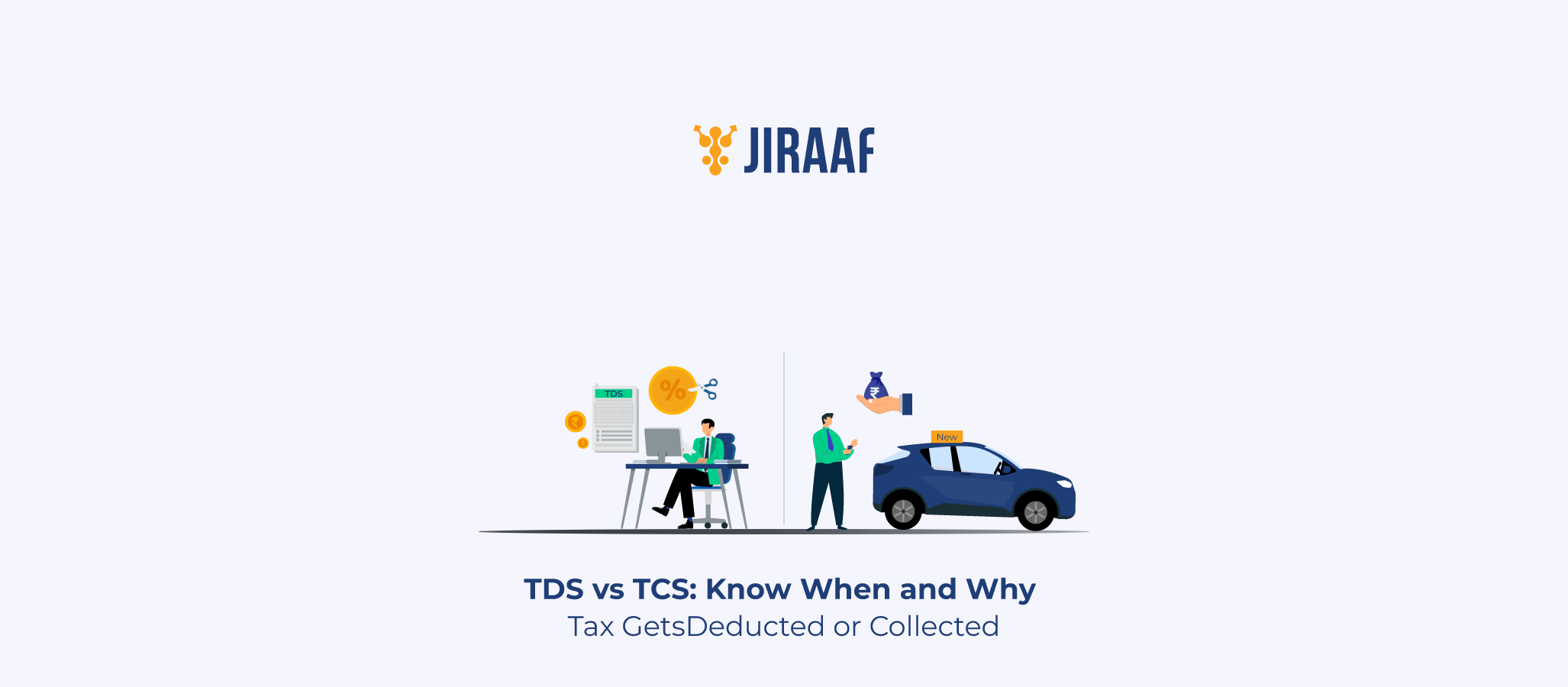
TDS and TCS—two tax terms that often commonly confuse taxpayers. You might spot them on your bank statements, invoices, or while filing your income tax return. But what exactly do they mean? Why does one get deducted from your earnings while the other gets added to your bill?
In simple terms, Tax Deducted at Source (TDS) ensures the government receives tax from your income right at the time it’s paid. On the other hand, Tax Collected at Source (TCS) ensures tax is collected when you make certain types of purchases. While both serve the same purpose—upfront tax collection—they work in entirely different ways.
In this blog, you’ll get a crystal-clear understanding of TDS and TCS, when each applies, how they impact your taxes, and what you need to watch out for to stay compliant.
What Is TDS?
TDS is a mechanism where tax is deducted at the point of income generation. The person making a payment (like salary, rent, or interest) deducts tax and deposits it with the government on behalf of the receiver.
In short, you receive income after tax is already deducted.
Common Scenarios Where TDS Is Applied
Here are a few situations where TDS is typically deducted:
- Salaries: Employers deduct TDS based on your income slab.
- Bank Interest: TDS at 10% if interest exceeds ₹40,000 in a year (₹50,000 for senior citizens).
- Rent Payments: 10% TDS if rent paid exceeds ₹50,000/month (Section 194IB).
- Contract Payments: 1–2% TDS is deducted for payments to contractors or freelancers (Section 194C).
- Sale of Property: Buyers deduct 1% TDS on property transactions above ₹50 lakh.
What Is TCS?
TCS is tax collected by a seller while selling certain specified goods or services. It’s the seller’s responsibility to collect tax from the buyer at the point of sale and deposit it with the government.
Unlike TDS, which applies on income, TCS applies on the transaction value.
Examples of TCS Collection
Here are some cases where TCS comes into play:
- Sale of Scrap: 1% TCS on sale of scrap material.
- Timber or Forest Produce: TCS between 2.5%–5%.
- Alcoholic Liquor: 1% TCS.
- Luxury Cars: TCS of 1% if value exceeds ₹10 lakh.
- Foreign Remittances under LRS: TCS of 5% for remittances above ₹7 lakh.
- Overseas Tour Packages: TCS of 5%, even on small amounts.
So, if you’re buying a foreign tour package worth ₹3 lakh, you’ll pay ₹3.15 lakh—with ₹15,000 going as TCS.
TDS vs TCS: Key Differences at a Glance
Both TDS and TCS aim to ensure timely tax collection and improve compliance, but they function differently.
| Feature | TDS | TCS |
| Applicability | On income | On sale of specified goods/services |
| Responsibility | Deductor (payer) | Collector (seller) |
| Time of Deduction/Collection | At the time of payment or credit | At the time of sale |
| Refund Claim | Can be claimed by payee if excess TDS deducted | Can be claimed by buyer while filing return |
| Common Examples | Salary, rent, bank interest, property sale | Car sales, overseas tours, scrap sale |
| Governing Sections | Sections 192–195 of the Income Tax Act | Sections 206C(1), 206C(1G), etc. |
Responsibility: Deductor vs Collector
- In TDS, the deductor (payer) is responsible for deducting and depositing the tax.
- In TCS, the collector (seller) is responsible for collecting and depositing the tax.
Both parties must issue certificates (Form 16A for TDS and Form 27D for TCS) to help the recipient claim credit.
TDS vs TCS Rates and Thresholds
Both TDS and TCS have their own rates depending on the nature of payment or transaction. Here’s a quick summary:
| Nature of Payment | TDS Rate | Threshold |
| Salary | Slab rates | N/A |
| Bank FD Interest | 10% | ₹40,000 (₹50,000 for seniors) |
| Rent (by individual) | 5% | ₹50,000/month |
| Sale of immovable property | 1% | ₹50 lakh |
| Contractor payments | 1%–2% | ₹30,000/single payment or ₹1 lakh/year |
| Nature of Sale | TCS Rate | Threshold |
| Alcohol, timber, forest produce | 1%–5% | No threshold |
| Luxury Cars | 1% | ₹10 lakh |
| Overseas Tour Packages | 5% | No minimum |
| Foreign Remittance (LRS) | 5% | ₹7 lakh/year |
Always check updated Finance Act provisions, as rates may change every year.
How TDS and TCS Impact Tax Filing
Both TDS and TCS reflect in your Form 26AS and Annual Information Statement (AIS), which you must reconcile while filing your Income Tax Return (ITR).
If You’re the Payee or Buyer
- TDS/TCS deducted is available as a tax credit.
- This amount gets adjusted against your total tax liability.
- If excess tax was deducted or collected, you can claim a refund while filing your ITR.
If You’re the Deductor or Collector
- You must file TDS/TCS returns (Form 24Q/26Q/27EQ) on time.
- Late filing attracts penalties under Sections 234E and 271H.
Neglecting these can cause trouble for both you and the other party involved.
Final Thoughts: Why Knowing the Difference Matters
Understanding these concepts helps you avoid unpleasant surprises—like mismatches in Form 26AS, delayed refunds, or compliance notices. But beyond compliance, a bigger advantage of differentiating between these taxes is better control over your tax planning. When you know how and where these deductions or collections happen, you can budget smarter, time your investments better, and avoid liquidity crunches.
FAQs
Can I claim credit for TDS or TCS deducted?
Yes, TDS and TCS both show up in Form 26AS or AIS, and you can claim credit while filing your ITR.
What happens if TDS is not deducted?
If the deductor fails to deduct TDS, they may face penalties and disallowance of expenses under Section 40(a)(ia).
Is TCS applicable for salaried individuals?
Not typically, unless they’re making high-value purchases (like luxury cars or overseas tours).
Can both TDS and TCS apply on the same transaction?
In rare cases, yes — for example, where one is selling goods with TCS and paying a contractor under TDS norms.
What’s the due date for depositing TDS/TCS?
Generally, 7th of the following month, and 31st May for March deductions.
Discover fixed income investments with Jiraaf, a SEBI registered online bonds platform that educates and brings access to a wide array of bonds. Sign up today to explore diversified fixed income investment opportunities to support your goal-based wealth creation journey. Start investing!